
How to Market a Plumbing Business: Emergency vs Planned
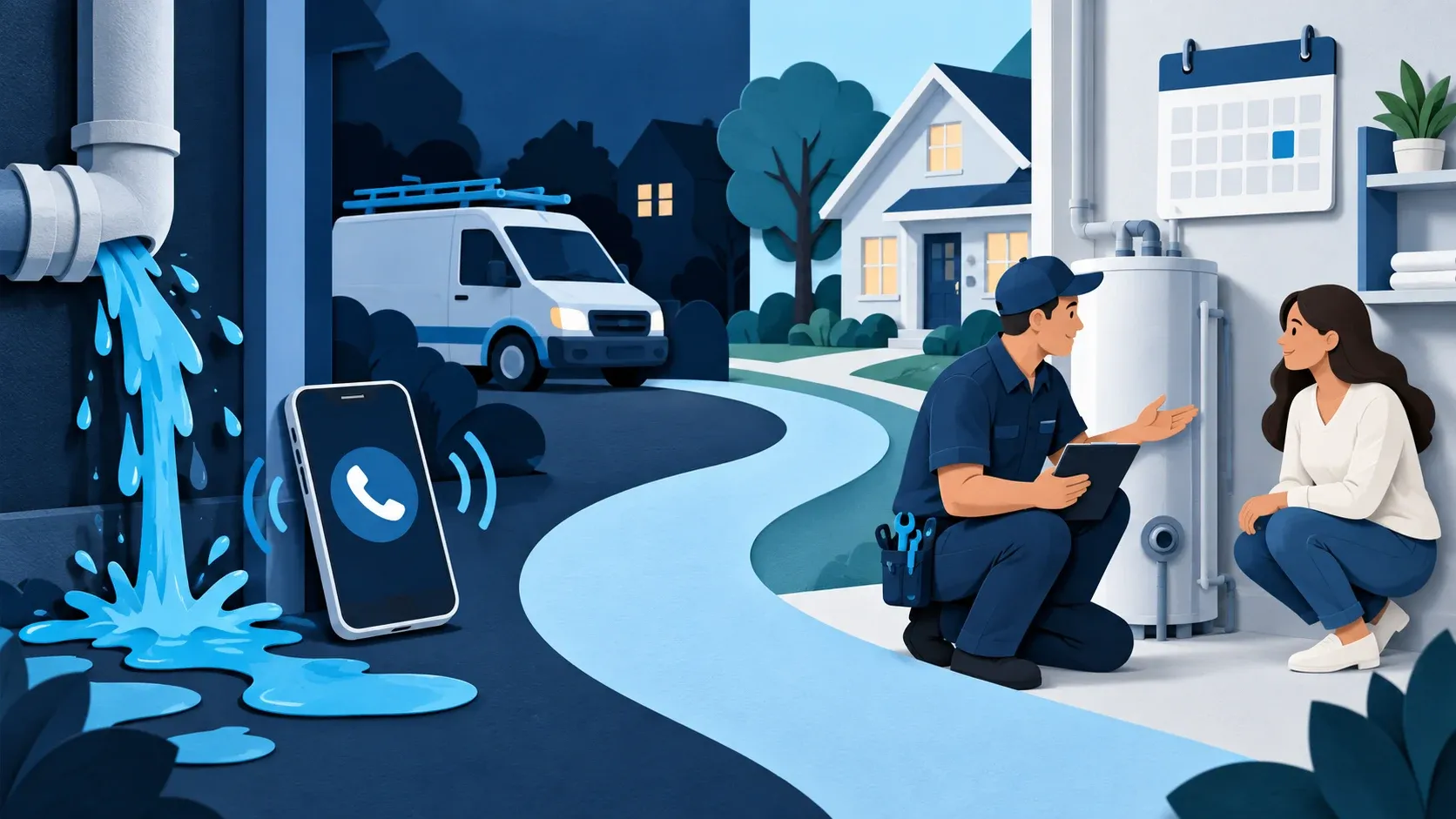
The freeze hits, and your phones light up. A flooded basement, burst line, or dead water heater can fill the board before trucks leave.
The forecast changes. Emergency calls slow, slots open, and revenue depends on a bad day.
The answer to how to market a plumbing business is not to stop marketing emergency work. Market urgent jobs for speed, availability, and a clear next step. Market planned work for trust, education, and follow up, so homeowners call you before failure forces their hand.
Those are two different buyers. The urgent homeowner has a leak, backup, no hot water, or spreading damage. They need confidence that you can solve it now. The planned homeowner is weighing a water heater replacement, sewer project, repipe, maintenance agreement, or project estimate. They have time to compare, ask questions, and choose the company they trust in their home.
A durable plumbing marketing system serves both mindsets. It captures calls that cannot wait, then turns every job into maintenance, replacements, referrals, and commercial account work. That is the difference between a schedule controlled by freezes and one you can plan around.
This guide lays out a revenue mix, how to convert one-time callers into future work, and how to judge digital marketing for home service businesses by closed jobs rather than traffic. Before choosing plumbing advertising ideas, identify which type of demand each tactic is meant to create.
Emergency and Planned Plumbing Jobs Need Different Marketing Paths
To market a plumbing business effectively, give emergency and planned jobs separate messages, offers, landing paths, and success measures. Both buyers may hire the same company, but treating them identically loses both.
A homeowner with water across the bathroom floor will not read a long guide about plumbing options. A homeowner considering a tankless water heater will not respond to a generic emergency offer.
Emergency Demand Is About Speed and Certainty
Emergency work includes problems homeowners cannot comfortably delay:
-
Burst pipes
-
Sewer backups
-
Overflowing toilets
-
Active leaks
-
No hot water
This buyer is stressed, usually on a phone, and comparing options quickly. They need proof that you serve their area, answer the phone, and can help now.
Your emergency marketing needs a simple route to booking:
-
A clear emergency-service message
-
Accurate hours and availability
-
Obvious service-area coverage
-
Mobile click-to-call buttons
-
A short booking form for callers who cannot talk
The conversion is an immediate call or booked dispatch. Judge these campaigns by booked emergency jobs, cost per booked job, and closed revenue from that service line.
Planned Demand Is About Confidence and Value
Planned work has a longer buying cycle. It includes water heater replacement, tankless upgrades, sewer line replacement, repiping, preventive inspections, and remodel-related plumbing.
These homeowners research options, compare scope and price, and look for evidence that you can handle an expensive project correctly. They may need financing information, project proof, reviews, and time to make the decision.
Planned-work marketing should help them learn before asking them to book:
-
Service-specific pages that explain the project
-
Before-and-after photos or project proof
-
Financing details, if offered
-
Consultation or estimate requests
-
Consistent estimate follow-up
A repipe lead should not be measured like a drain emergency. It may take longer to close, but its revenue and margin can be very different.
Map Every Service to a Revenue Role
Map each core service before adding ad spend, publishing pages, or judging channel performance.
| Core service | Buyer mindset | Primary goal | Likely first touch | Conversion action | Closed revenue measure |
|---|---|---|---|---|---|
| Drain cleaning | Urgent | Restore service fast | Google search or Google Business Profile | Call and dispatch | Closed drain jobs |
| Leak repair | Urgent | Stop damage | Mobile search | Call and dispatch | Closed repair revenue |
| Water heater replacement | Planned | Compare options | Service page, search, or referral | Estimate request | Closed replacement revenue |
| Repiping | Planned | Choose a trusted specialist | Educational page or project proof | Consultation | Closed repipe revenue |
| Sewer line replacement | Planned or urgent | Understand scope and risk | Search, reviews, or referral | Camera inspection or estimate | Closed sewer-project revenue |
Branding, truck visibility, referrals, reviews, and a strong Google Business Profile can support both journeys. Their role changes by funnel stage. A review can help an emergency caller decide in minutes, while project photos can build confidence for a repipe prospect over weeks.
Next, build the urgent side of the plan around the homeowner who needs help now.
Build an Emergency Plumbing Marketing System That Books the Call
How do you win the homeowner searching for an emergency plumber at night with water spreading across the floor? They need to find you, trust you, and reach a real booking path in seconds.
That is how to market a plumbing business for emergency demand. Visibility without trust loses the call. Paid traffic without an answered phone wastes money.
Own the Urgent Local Search Moment
Start with your Google Business Profile. It needs accurate hours, relevant emergency service categories, a clearly defined service area, current job photos, and recent customer reviews. Google's Business Profile guidelines require businesses to keep core information accurate.
A homeowner comparing plumbers looks for signs that you are active, local, and equipped to handle the problem. An outdated profile, unclear hours, or old photos creates doubt when you need them to call.
When your team has capacity, Local Services Ads and high-intent Google search campaigns can put you in front of homeowners actively looking for help. Paid search captures emergency demand at the moment intent is highest, but it requires answered phones and fast booking to convert that spend into revenue.
Do not create demand you cannot serve. If you advertise emergency availability, your staffing, dispatch coverage, and phone handling must match.
Send Urgent Visitors to an Urgent Experience
An emergency search should lead to an emergency plumbing page or campaign landing page, not your generic homepage. The page should match the problem the homeowner searched.
State which emergencies you handle, where you work, when you are available, and how to reach a person immediately. Include current reviews, license and insurance details where applicable, and proof that you perform the work homeowners need.
Emergency callers judge your site in seconds. If they have to hunt for a phone number, wonder whether you cover their area, or load a slow page, they will find someone else.
Keep the page focused on four essentials:
-
Immediate phone action: A prominent click-to-call option on mobile
-
Clear emergency scope: The urgent problems you handle
-
Trust proof: Reviews, photos, credentials, and local service-area details
-
Fast mobile loading: A page that opens quickly when the homeowner needs help
An emergency lead is only valuable if your team can turn urgency into a booked job.
Protect the Lead After It Arrives
Marketing did not succeed because the phone rang. Track every emergency inquiry through the operating chain:
-
Answered
-
Qualified
-
Booked
-
Dispatched
-
Sold
Call reviews and CSR coaching show whether you have a lead-quality problem or an office conversion problem. Those require different fixes. A qualified caller who reaches voicemail and hangs up is not a marketing problem. An answered call that does not book is not a traffic problem.
Use marketplace leads carefully. Test them with a fixed budget, then judge the source by cost per booked job and cost per sold job, not a cheap cost per lead.
Emergency work fills today's board, but planned demand gives you more control over next quarter's revenue.
Planned Plumbing Jobs Are Won Before the Emergency Happens
Planned plumbing jobs are won before the emergency, when homeowners already trust you to explain a replacement decision.
A homeowner calls about a leaking water heater, and your technician finds a tank near the end of its life. The repair solves today's problem, but the replacement decision may come next week, next month, or after the next leak.
Build dedicated service pages for the work homeowners research carefully:
-
Water heater replacement
-
Tankless water heater installation
-
Sewer line repair and replacement
-
Repiping
-
Drain and sewer solutions
Each page should answer questions your office hears before someone requests a quote. Cover repair versus replacement, warning signs, project expectations, factors that affect scope, and questions homeowners should ask before approving work.
That is not content for a blog calendar. It is sales support for a homeowner trying to avoid an expensive mistake.
Use job photos, technician explanations, customer reviews, and clear project steps to make technical work understandable. A homeowner may not know what a failing sewer lateral or galvanized repipe involves. They can still recognize a company that shows its work and explains the process plainly.
SEO and content build planned demand when each page serves a specific job and buyer question.
Give Planned Visitors a Relevant Next Step
An emergency visitor needs to call now. A planned-project visitor may need an estimate request, a consultation, financing information if you offer it, or time to discuss the project with a spouse.
Do not send every visitor to the same generic "Call Now" message.
Match the action to the decision:
-
A water heater replacement guide can link to an estimate request.
-
A tankless installation page can offer a consultation.
-
A repiping guide can explain the inspection process before requesting contact information.
-
A sewer replacement page can link to camera inspection or project estimate information.
Once an estimate is sent, follow-up should be a system, not a note in a dispatcher's inbox. Define who owns it, when they contact the prospect, what message they send, and whether the estimate was approved or declined.
Track the outcome. An estimate lost over scope concerns needs a different response than one lost because nobody followed up.
Add Stable Account Work Outside the Emergency Cycle
Residential demand should remain your foundation, but account relationships can complement it. Property managers, real estate professionals, HOAs, facilities teams, and businesses with repeat plumbing needs value a contractor who communicates clearly and documents the work.
Keep the offer simple:
-
Responsive communication
-
Documented scope and completed work
-
Priority scheduling when your operations can support it
-
Clear points of contact
This does not replace homeowner marketing. You still need visible local search results and useful project pages for residential work.
A guide only creates value when the homeowner can act on it. Place contextual calls to action, links to the related service page, and customer proof near the estimate or consultation option.
The most valuable planned lead may be a customer who originally called because of an emergency.
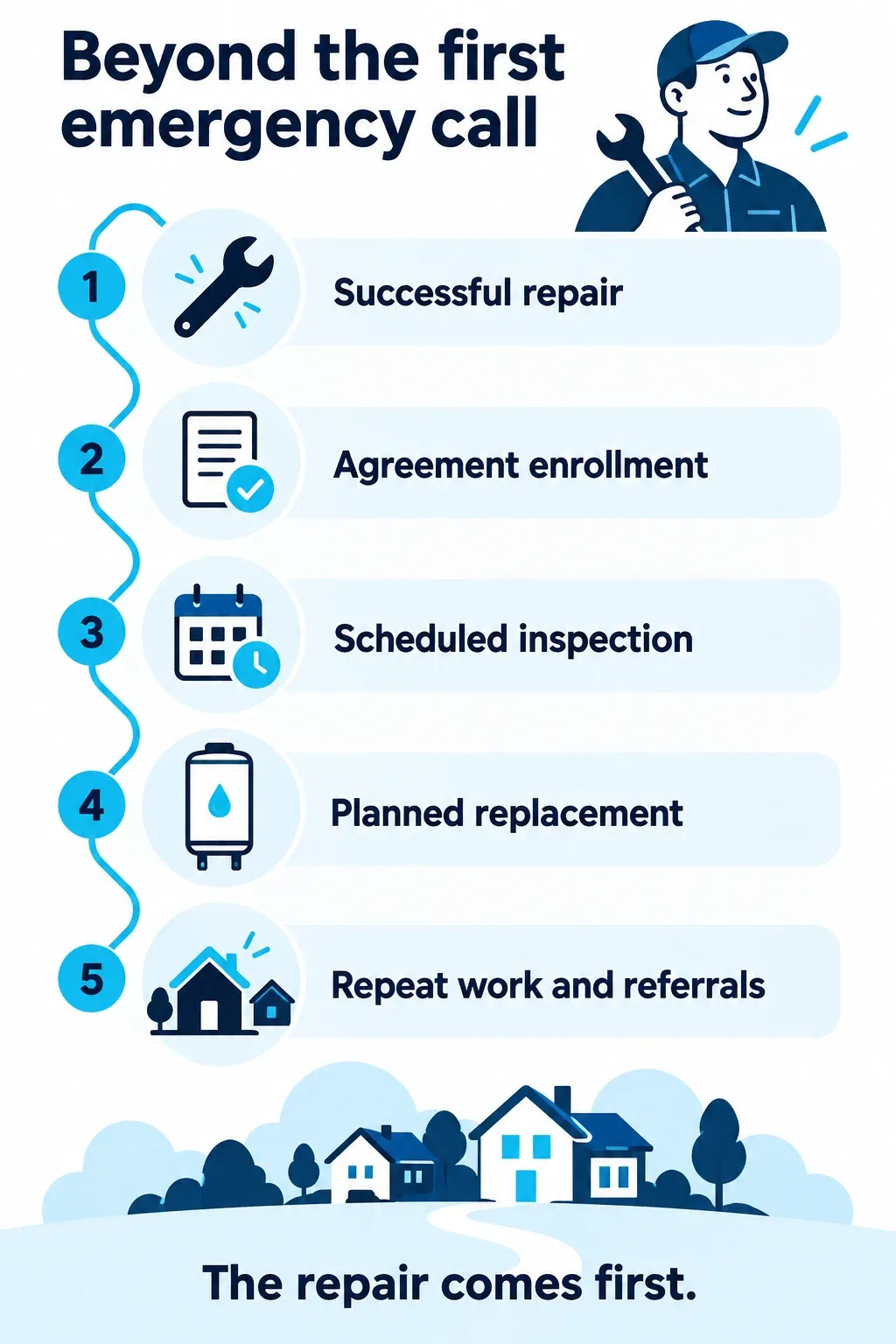
How to Market a Plumbing Business Beyond the First Emergency Call
The cheapest future plumbing lead is often the homeowner whose emergency you already solved well. You earned their attention during a stressful moment. Now give them a useful reason to call you before they face the next one.
A service agreement is not a discount club. It creates scheduled touchpoints, helps your team identify planned work earlier, and gives homeowners a company that already knows their plumbing system.
Design Agreements Around Value You Can Deliver
Build agreements around benefits your office and field team can consistently honor. Priority scheduling only works when capacity allows. Member savings only work when customers understand exactly where they apply.
A simple Good, Better, Best structure keeps the choice clear:
| Option | Core homeowner value |
|---|---|
| Entry | Annual plumbing inspection and maintenance reminders |
| Mid tier | Inspection, a defined maintenance benefit, priority scheduling where available, and a clear member savings policy |
| Premium | Additional coverage or benefits your team can deliver without losing money on each visit |
Put the terms in plain language before enrollment. Define:
-
What the agreement includes and excludes
-
Eligible equipment or systems
-
How member savings apply
-
Renewal and cancellation steps
-
Limits on priority scheduling
Do not promise free work, unlimited coverage, or immediate scheduling your dispatch team cannot deliver.
The agreement should make the homeowner's next plumbing decision easier, not make your pricing harder to explain.
Offer Enrollment After You Earn the Right
Introduce the agreement after a successful repair, not while a homeowner is staring at water on the floor. Your technician or customer service representative can raise the option at invoice presentation, not mid-job.
Keep the conversation in homeowner language: fewer surprises, reminders before maintenance is due, and a clear path to help from a company that knows the system.
The repair comes first. The relationship conversation comes after the homeowner feels relief.
Consider an emergency water heater repair. Your team restores hot water, documents the unit's condition, and offers an agreement with an annual inspection. At that inspection, you can revisit replacement options while the homeowner still remembers how reliable you were during the emergency.
Use a Retention Calendar, Not a Generic Blast
Follow-up should reflect what you know about the customer's service history. A sewer customer needs different reminders than a homeowner with an aging water heater.
Build workflows for specific segments:
-
After completed work: Send a thank-you message and review request.
-
Seasonal prevention: Send relevant freeze, drain, or water heater reminders.
-
Maintenance due: Remind agreement members when inspection is due.
-
Unsold estimates: Follow up based on service type and the homeowner's stated objection.
-
Satisfied repeat customers: Ask for a referral after a positive completed job.
Reviews and referrals are not isolated marketing chores. They become proof and acquisition assets when excellent service, clear communication, and respectful follow-up give homeowners something worth sharing.
Retention improves the math, but only if you can see which lead sources and job types are actually profitable.
Set Your Plumbing Marketing Budget by Profitable Jobs, Not a Percentage
More than $80M in annual revenue generated for our home service clients has reinforced one rule: there is no responsible universal plumbing advertising budget. Your acceptable acquisition cost depends on your service mix, margins, close rate, and the lifetime value of a well-served customer.
A percentage of revenue can hide bad decisions. A drain cleaning call, a sewer replacement, and a recurring property management account cannot carry the same marketing cost.
Start With Your Service Line Economics
Pull your own profit and loss statement, service line reports, and CRM data before increasing any budget. Do not use a generic margin benchmark from an agency, trade group, or Facebook group. Use the actual numbers from your business.
For each priority service, identify:
-
Average collected revenue per sold job
-
Direct job cost and overhead contribution
-
Lead to sold job close rate
-
Available technician and dispatch capacity
-
Repeat purchase, membership, referral, or account potential
-
Marketing cost by source
Set an acquisition cost ceiling only after you know what a sold job contributes and what that customer could be worth after the first call.
A campaign can look cheap at the lead level and still lose money. If leads do not book, estimates do not close, or the job leaves little contribution after direct costs, a low cost per lead does not help you.
Closed revenue is the score. Impressions, traffic, rankings, and lead volume are diagnostics.
Follow Every Lead Through to the Sold Job
Your report should show where each lead entered and what happened next. A simple scorecard makes weak links visible:
| Source | Lead type | Qualified leads | Booked jobs | Sold jobs | Closed revenue | Cost per sold job | Job margin |
|---|---|---|---|---|---|---|---|
| Google Ads | Emergency repair | - | - | - | - | - | - |
| Google Business Profile | Water heater replacement | - | - | - | - | - | - |
| Referral | Sewer project | - | - | - | - | - | - |
| Shared lead platform | Drain cleaning | - | - | - | - | - | - |
A low cost lead is not a win if it never books or produces a weak-margin job.
This scorecard separates a marketing problem from an operations problem. If qualified calls are missed, poorly qualified, or followed up late, more ad spend will not fix the leak.
Call tracking and CRM attribution connect the dots. Inbound Intel AI, built on CallRail, identifies the lead source and booking outcome. ServiceTitan, Housecall Pro, or your field service CRM should confirm the sold job and closed revenue.
Reallocate for Shoulder Season Without Cutting the Foundation
When emergency volume softens, do not cut every channel equally. Reduce spend where capacity is full or job economics no longer work. Protect the assets that create planned demand: service content, local visibility, reviews, database marketing, and account relationships.
This is how you do not let one channel own your revenue. Emergency search can fill today's board. Planned replacement content, repeat customers, and account relationships help fill the weeks when urgent demand drops.
Shared lead platforms may deserve a controlled test. Set a fixed spend limit, track the source through sold jobs, and do not mistake lead volume for success. Scale only when acquired jobs produce enough margin and your team has capacity to serve them.
Marketing is not working until you can trace spend to booked, sold, and profitable plumbing jobs.
Audit Your Plumbing Demand Mix Before You Spend Another Dollar
A healthy plan for how to market a plumbing business does not force you to choose between emergency calls and planned work. It gives each one a job.
Emergency marketing keeps today's board full when homeowners need immediate help. Planned services, customer retention, and account relationships create steadier demand when urgent calls slow down. The goal is not to promote every service equally. It is to protect profitable urgent work while building a pipeline you can influence.
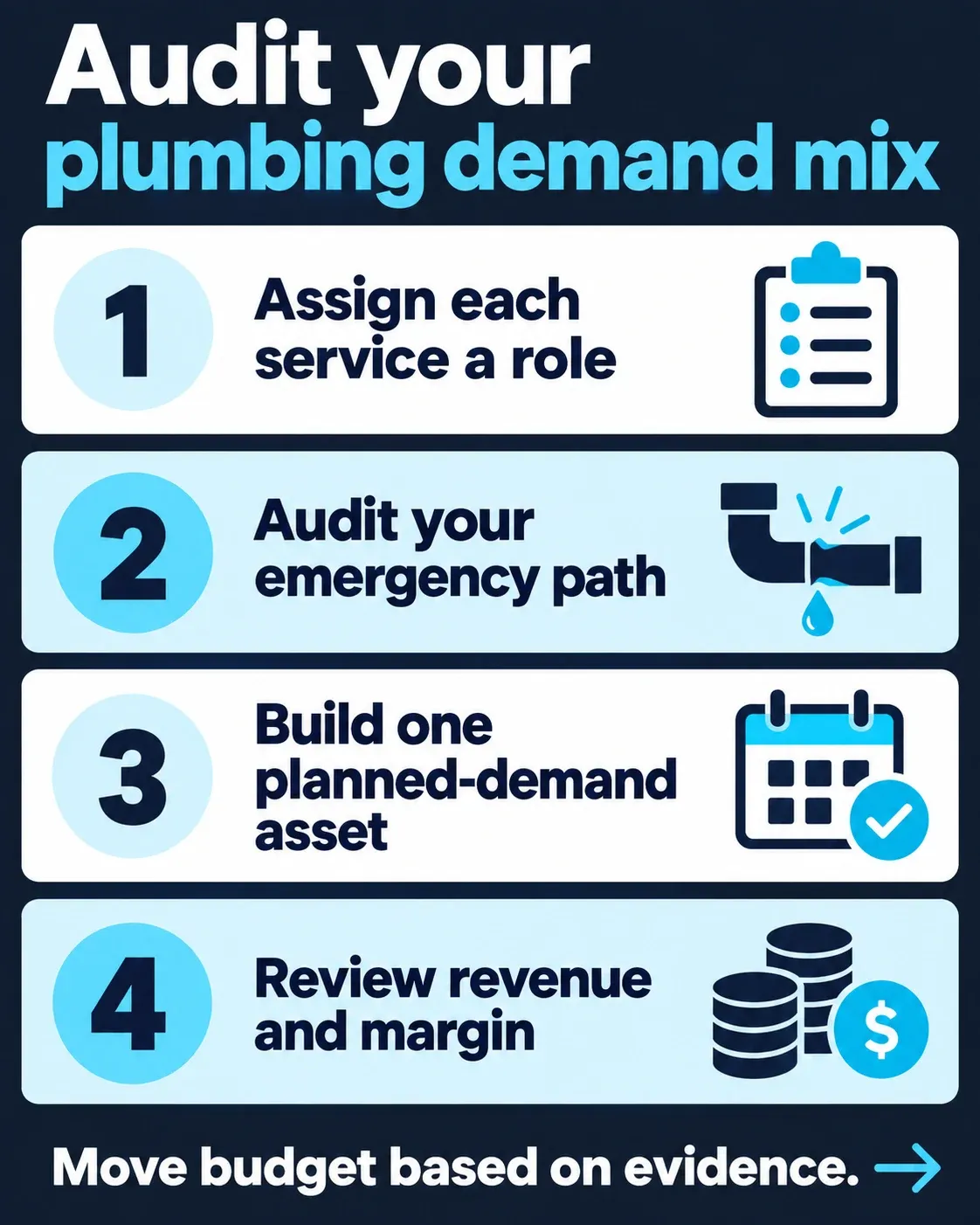
Run this four-step audit this week:
-
List your core services and assign each a role. Label every service as emergency, planned, recurring, or account based. A drain backup and a repipe need different messages, landing pages, follow-up processes, and acquisition targets.
-
Audit your emergency path. Search for your business as a homeowner would. Can someone get from a Google result to an answered call and booked job without friction? Check your Google Business Profile, mobile call buttons, stated availability, phone coverage, and dispatch process.
-
Build one planned-demand asset and one follow-up workflow. Choose a high-value service your team wants more of, such as water heater replacement, sewer work, or repiping. Create one focused page, offer, or campaign around it. Then build a follow-up process for past customers or unsold estimates tied to that service.
-
Review closed revenue and job margin by source each month. Use your scorecard to identify which channels produce profitable sold jobs. Move budget based on evidence, not lead volume, clicks, or agency reports full of charts.
Do not add more plumbing advertising until you know whether the real leak is visibility, conversion, response time, or follow-up.
If you want an outside view, book a strategy call. The Elevated Audience team will review your revenue goals, current demand mix, conversion gaps, and attribution setup. Then they will identify which emergency and planned paths need work first.
Qualified leads within 60 days or your next month is free.
Frequently Asked Questions
What is the best way to market a plumbing business?
The best way to market a plumbing business is to build a balanced system that captures urgent local searches, creates planned demand for high-value work, and reactivates past customers. This gives you work for today while building a pipeline that is less dependent on weather, freezes, and emergencies.
The right mix depends on your service area, services, technician capacity, and job economics. A company focused on drain calls needs a different plan than one trying to grow water heater replacements, sewer projects, or property-management accounts.
What plumbing advertising works best for emergency calls?
Local visibility, Google Local Services Ads where eligible, high-intent paid search, recent reviews, and a fast mobile booking path work best for emergency plumbing calls. Homeowners with active leaks, backups, or no hot water want a clear answer to one question: can you help me now?
Do not advertise immediate availability if your office cannot answer and book calls quickly. An unanswered emergency lead is not a marketing win, and more ad spend will not fix a missed-call or dispatch problem.
How do plumbing service agreements help customer retention?
Plumbing service agreements help retention by creating scheduled contact, offering practical homeowner benefits, and making your company the easier choice for the next call. They give you a reason to reconnect before a small issue becomes an emergency or replacement decision.
The plan must be simple and deliverable. Put inclusions, exclusions, cancellation terms, renewal details, savings policies, and priority-scheduling limits in plain language before a customer enrolls.
How should I decide what I can afford to pay for a plumbing lead?
Decide what you can afford to pay for a plumbing lead by working backward from collected revenue, direct job costs, overhead needs, close rate, and expected future customer value. A lead is only worth what the sold job, repeat work, referrals, or agreement enrollment can profitably support.
Cost per lead alone is not enough. Track cost per booked job, cost per sold job, closed revenue, and job margin by source and service line. A low-cost drain lead may still lose money if it rarely books or produces weak-margin work.
Are Angi, Thumbtack, and other shared lead platforms worth it for plumbers?
Angi, Thumbtack, and other shared lead platforms can be worth a limited test for selected plumbing job types, but they are not a guaranteed growth engine. You may compete with other contractors for the same homeowner, which can reduce response-time advantages and close rates.
Set a fixed test budget, restrict the service area and job types, and define fast response standards before buying leads. Measure each platform through booked jobs, sold jobs, closed revenue, and margin before increasing spend.