
Garage Door Marketing That Books Spring Repairs and Sells Replacements
Garage door marketing has two demand problems. A homeowner with a broken spring needs an answer right now. A homeowner shopping for a new door needs a path that protects your margin.
We build search visibility, paid demand capture, conversion paths, and revenue attribution around both jobs. Then we track whether those leads became booked work and closed revenue.
Qualified leads within 60 days or your next month is free.
Repair Calls and Replacement Projects Need Different Paths
Garage door lead generation cannot treat a broken spring call and a new door purchase as the same lead.
Your schedule can fill with urgent repair work while replacement opportunities arrive inconsistently, get priced too low, or never reach an estimate appointment. A blended lead total hides that difference.
Emergency Repairs Require a Fast Call Path
A homeowner with a door that will not open is usually on a phone, looking for a company that can help now. The search, the ad, and the landing page need to make calling simple.
Your urgent services should be clear, your phone number easy to tap, and the page should answer the immediate concern without a long form.
Common urgent searches include:
- Broken garage door springs
- Failed garage door openers
- Off-track garage doors
- Doors that will not open or close
The handoff after the click matters as much as the ad or the page. A caller who reaches voicemail will call another company. That is not a traffic problem.
Replacement Buyers Need Information Before an Estimate
Door replacement is a different decision. The homeowner may compare styles, materials, insulation, warranties, and installation options before contacting anyone.
That path should include project galleries, product details, warranty information, and financing options when you offer them. The estimate request should collect enough project context for your team to prioritize the right jobs.
A replacement page can also set expectations before your estimator arrives. It can explain the consultation process, show completed installations, and give the homeowner a clear next step.
What You Can Afford to Spend on a Garage Door Lead
A spring repair books for a fraction of what a full replacement sells for. What you can afford to spend per booked job depends on your ticket mix, your close rate, and how fast your team picks up the phone.
No honest agency can hand you a cost per lead target without knowing your repair to replacement ratio. Any flat number that ignores those variables costs you money.
Four numbers set what you can afford to pay for a booked job.
- Ticket size. The gap between a repair call and a replacement changes your entire margin structure.
- Repair and replacement mix. A company running 60 percent replacements can afford a higher cost per lead than one running 80 percent service calls.
- Close rate. The percentage of real leads that become booked, paying jobs.
- Answer speed. Garage door customers call two or three companies and hire the first one that answers.
Once you know those four numbers, you can set a cost per booked job that leaves real margin. The system we build tracks all four from your own data rather than an industry average.
Build a Search System for Repair Calls and Replacement Demand
Digital marketing for garage door companies should put you in front of homeowners when they search, while building assets that keep working when ad spend changes.
Waiting to build local visibility leaves you dependent on whichever paid channel is producing that month. Repair demand shifts quickly, and replacement work takes a longer path from research to estimate.
Local Search Creates a Base You Own
Your Google Business Profile is often the first thing a homeowner sees in a local search. It needs accurate service categories, current hours, correct service areas, fresh photos, and a process for requesting and responding to reviews.
Profile compliance matters. A suspended profile can remove a major source of local visibility while you work to resolve it.
Your website supports that profile with pages built around the jobs and places you serve. A broken spring repair page should not compete with a garage door replacement page.
The local foundation includes:
- A maintained Google Business Profile
- Accurate local citations across trusted directories
- Review support based on completed jobs
- Focused repair, replacement, and location pages
Local SEO is ongoing work. You keep business information accurate, strengthen pages tied to profitable jobs, and make it clear where and how you serve homeowners.
Local Services Ads and Google Ads Capture Immediate Intent
Google Local Services Ads provide a direct path to urgent repair leads, but the account needs regular attention. Eligibility documentation, insurance records, and license information must stay current where required.
Fast lead handling matters. A homeowner with a stuck door wants service now, not information for next month. If your team cannot answer and book the call promptly, more visibility will not solve the real problem.
Google Ads gives you more control over the searches you target. It can support high intent repair terms, replacement searches, and your company name when competitors bid on it.
The work is in the campaign structure, not in turning ads on. That means negative keywords that block irrelevant searches, separate repair and replacement messaging, and a landing page that matches each click.
Which One Should You Start With
Think of it as land. Google Ads and Local Services Ads rent you a spot at the top of the page. The rent buys immediate coverage, and the moment the budget stops or a card declines, the spot is gone.
SEO buys the property. It takes longer to build on, it will not help you this week, and nobody can hand you a deed by a specific date.
Most garage door companies need both, in that order. Paid search covers the repair calls while the organic foundation gets built underneath it.
Your Website Should Route Repair Calls and Replacement Leads Differently
A broken spring creates an immediate service need. A replacement project begins with research, comparisons, and questions about options. Treating both visitors alike slows repair calls and weakens replacement margins.
Repair Visitors Need a Fast Mobile Experience
A repair visitor is usually on a phone looking for a company that can handle the problem now. Do not send that homeowner through a long estimate form just to reach your team.
For urgent garage door work, the page should include:
- A clear click to call option on mobile
- Repair specific service information
- Proof that matches the repair need
- A short path to dispatch or scheduling
A repair lead can become another company's booked call within minutes. Route it to the person who can schedule or dispatch it.
Replacement Buyers Need More Context Before They Commit
Homeowners comparing door styles, materials, insulation, warranties, and financing need a different conversation. Your replacement pages should show the work you want more of.
Use project examples and product context. Include warranty details and financing information if you offer it. The estimate request should collect door type, project scope, and homeowner timeline.
A conversion focused site protects replacement margin by qualifying the project before the estimate.
Capture Visitors Who Want a Starting Number
Some replacement visitors leave because they want preliminary pricing before speaking with anyone. Instant Estimator AI gives them a preliminary estimate based on service type and project details, then captures the lead rather than losing it.
After installation, Instant Estimator AI lifted conversion rates 40% to 60%. That lift was measured across other home services deployments, not a garage door installation.
The estimator does not replace your sales process. It gives homeowners a reason to provide project details and gives your team a clearer handoff.
Your Team Still Has to Answer the Lead
A better website cannot fix an office that does not answer calls or return estimate requests. It can make the breakdown visible.
Lead capture, automated routing, and source attribution show where the handoff failed. You still need to answer the phone, respond to forms, and follow up on replacement inquiries.
You need to know whether the site failed to convert or the lead was lost after it arrived. Those are different problems with different fixes.
Reports Should Connect Marketing Spend to Closed Revenue
A useful marketing report shows more than clicks, form fills, rankings, or raw call totals. It should show which leads were real opportunities, which ones booked, and which sources produced closed revenue.
A raw call count can make a bad month look productive. Spam, existing customer service calls, wrong service area contacts, and missed calls inflate the number without adding work to your schedule.
See What Happened After the Lead Came In
Inbound Intel AI, our proprietary platform built on CallRail, reviews inbound calls, web forms, and Local Services Ads leads. It separates real opportunities from contacts your team could never turn into a job.
It also shows what happened with the viable ones. You can see missed calls, voicemails, booking outcomes, and where a CSR lost a caller who had a real chance to book.
The report should tell you whether marketing failed or your front desk lost the call.
Match Lead Sources to Sold Jobs
Lead tracking is only half the answer. Inbound Intel AI connects with ServiceTitan, Housecall Pro, or a comparable field service CRM, where quoted and sold job values live.
That connection lets you review the revenue trail by lead source, campaign, individual ad, quoted value, and sold value. You can see whether repair leads, replacement inquiries, or any single channel produces work your team actually closes.
Rankings and traffic are diagnostics. Closed revenue is the scorecard.
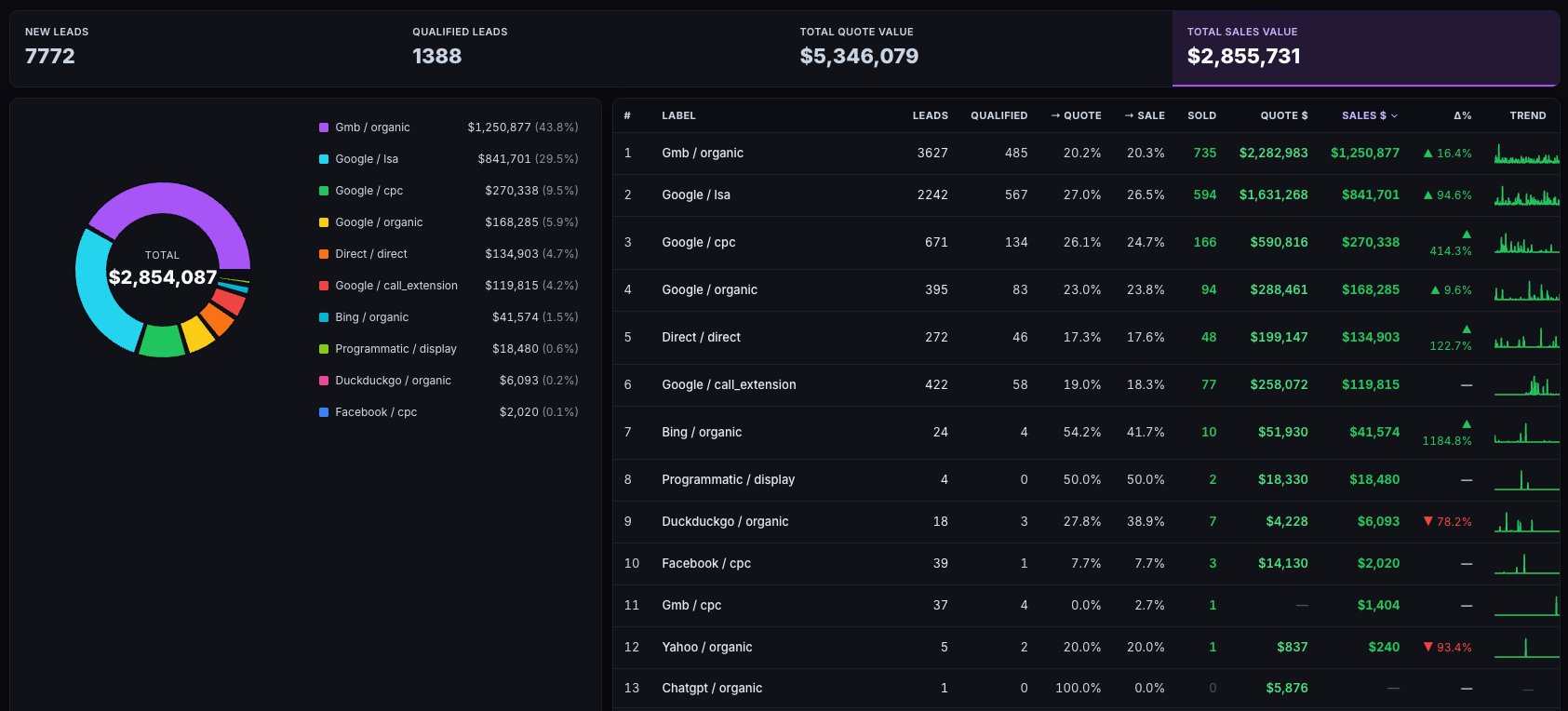
Proof of the Attribution System
Mountain Valley Plumbing is a plumbing and HVAC client on the Colorado Front Range, not a garage door client. We include this to show what the tracking system produces, not to predict a garage door outcome.
From April to August 2026, their monthly ad spend was cut 75% while tracked leads per month rose 2.4x. That period produced $640k in tracked closed sales on $36k in ad spend, a 17.6x return on ad spend.
Tracked closed sales are closed job values from the client's CRM, matched back to the originating lead through Inbound Intel and attributed to first touch.
Across our home service clients, that approach has generated more than $80M in annual revenue. Our client retention rate is 97%, we hold 5.0 stars across 36 Google reviews, and we are a Google Partner.
If your current report cannot connect spend to booked jobs and closed revenue, it cannot tell you what to fix.
What Garage Door Digital Marketing Costs and What Changes It
Garage door digital marketing starts at $2,495 per month. No setup fee. No contract: every program is month to month. Ad spend is separate and stays in your own Google and Meta accounts.
The starting investment covers one market and one Google Business Profile. It includes your website and hosting, local SEO, Local Services Ads and Google Ads management, plus Inbound Intel AI and Instant Estimator AI.
Your investment changes based on the growth goals you set and the gap your current marketing needs to close. It also depends on:
What changes the investment
- Your growth goals and the gap we need to close.
- How many primary markets you want to own and the size of your service area.
- Which channels: Google LSA and Google Ads, or Meta Ads on top.
- The number of Google Business Profiles you own.
- Your appetite for aggressive or sustained growth.
Full program pricing is a strategy conversation, not a table on a page. The starting price is real, and we explain what moves it before you commit to anything.
Cheap marketing fails for a simple reason. Limited resources and low quality strategy force shortcuts, and the shortcuts are what cost you rankings, budget, and booked jobs.
Multi-location groups and companies above $15M in annual revenue get a custom scope. That is a different conversation.
Who This Is For and Who It Is Not
Garage door companies between $500k and $8M in annual revenue who want to book more emergency repairs and close more replacements through organic search and paid media.
You are a fit if:
- Your team answers the phone during business hours
- You follow up with leads the same day
- You want attribution tied to closed revenue, not just call volume
- You are committed to growth, not just staying busy
Who This Is Not For
Marketing cannot fix an unanswered phone or an estimate request that never gets a callback. This is not a fit for contractors who do not answer their phone, do not call people back, or are not committed to growth.
The system generates leads. If the front desk does not book them, neither side wins.
What Happens to Your Accounts If You Leave
You own everything: your website, analytics, Search Console, ad accounts, call data, and every asset we produce.
Your Google and Meta accounts stay in your name, and your tracking data stays accessible to your team. If you leave, you take the foundation you paid to build.
Most contractors who have worked with an agency before have experienced the opposite. That experience is exactly why ownership is a non negotiable term on every program.
Switching Does Not Mean Starting Over
We do not automatically discard your current site, campaigns, or content. We first identify what worked, what did not, and what should be repurposed or pruned.
We will not call every prior decision wrong just to justify a rebuild. The work follows the evidence in your accounts and the results your office can close.
On our Grow and Scale programs, we will not take a competing contractor in your primary zip code for as long as you are with us. That term does not apply to the starting program.
What a Client Said
"We've been working with Elevated for about a year, and it's been an excellent experience from start to finish. They completely rebuilt our website, and the end result exceeded our expectations. We now rely on them for all of our digital marketing, and the consistency, communication, and results have been outstanding. Partnering with Elevated has been one of the best business decisions we've made in recent years."
Garage Door Marketing Questions, Answered
What Does Garage Door Marketing Cost?
Garage door marketing starts at $2,495 per month. No setup fee, no contract, month to month. Ad spend is separate and stays in your own Google and Meta accounts.
Your investment changes based on the markets you serve, the gap between current performance and your growth goal, and the channels required. Crew capacity and answer speed matter too.
How Do I Know Whether a Garage Door Lead Is Worth Paying For?
A lead is worth paying for if the cost to acquire the booked job leaves enough gross margin after your team sells and completes the work. There is no universal cost per lead that works for every company.
A spring repair and a replacement installation have different ticket sizes, margins, close rates, and sales cycles. Review answer speed, booking rate, and closed revenue by source. A cheap lead that never books is not cheap.
How Long Does Garage Door SEO Take?
SEO develops in three phases. Days 1 to 90 build the foundation, days 90 to 180 drive market penetration, and days 180 to 365 compound.
No provider can honestly guarantee a specific ranking by a specific date. Progress depends on your site's starting condition, local competition, the number of markets, and content capacity. SEO also will not fix missed calls or a dispatcher without capacity.
What Happens If I Leave or Switch Agencies?
You keep your website, analytics, Search Console, ad accounts, call data, and every asset produced. Your accounts stay in your name, so leaving does not mean losing the marketing foundation you paid to build.
Before a transition, we review access, lead sources, campaigns, service pages, and reporting. The goal is to identify what worked, what did not, and what should be retained or improved.
Do You Have Garage Door Marketing Case Studies?
No. We do not currently have a garage door client case study. We do not present HVAC, plumbing, electrical, or other trade results as proof of garage door performance.
That limitation matters because garage door companies balance same day repair calls with higher consideration replacement projects. The review starts with your own market, lead mix, and measurement gaps.
Ready to Book More Jobs?
Book a call and we will pull your market data, review your current lead sources and reporting gaps, and show you where the opportunity is. Qualified leads within 60 days or your next month is free.