


Book a Strategy Call

Local SEO for Home Service Contractors

Map Pack visibility for HVAC, plumbing, electrical, and roofing contractors does not happen by accident. It comes from accurate business information, a well-configured Google Business Profile, consistent citations, and pages that give Google a clear picture of where you work and what you do. This page walks through each piece and explains how it connects to booked jobs.

An Elevated Audience strategist reviewing local search performance for a contractor

What Local SEO Means for a Service Area Business

Local SEO for home services is the work that helps Google connect your business to searches happening in the neighborhoods where your crews operate. It is not a single tactic. It is a connected system of accurate business data, profile configuration, website architecture, and local signals that tell Google what you do, where you do it, and why your business belongs in the results.

Nearly 46% of all Google searches carry local intent. A homeowner searching for an HVAC company, a plumber, or an electrician is not reading a national publication. They want someone who can show up. That search behavior is why Map Pack placement matters more than most other ranking positions for contractors who depend on service area calls.

For a service area business, local SEO works differently than it does for a storefront. There is no physical location pulling nearby searchers. Visibility depends on how well the profile, website, and local data align with the real service footprint. The practical framework comes down to three things Google evaluates: relevance, distance, and prominence.

  • Relevance: How closely your services and business information match the search
  • Distance: The relationship between the searcher's location and your declared service area
  • Prominence: Your standing based on reviews, links, citations, and local search history

How Google Picks the Three Businesses in the Map Pack

The Map Pack is Google's way of surfacing local businesses for location-sensitive searches. When a homeowner searches for an HVAC contractor, plumber, or electrician in their area, Google evaluates every nearby business against relevance, distance, and prominence to decide which three listings to surface at the top of the results.

None of these factors has a shortcut. A thin location page does not change distance, and keyword stuffing in a profile description does not fix weak relevance. Good visibility comes from accurate information maintained consistently across your Google Business Profile, website, service pages, and business directories.

Google's local results are not a single citywide leaderboard. Map Pack visibility changes based on the searcher's location, the wording of the search, the service needed, and the competing businesses ranking for that specific query. A contractor can rank well in one part of a metro area and disappear two miles away.

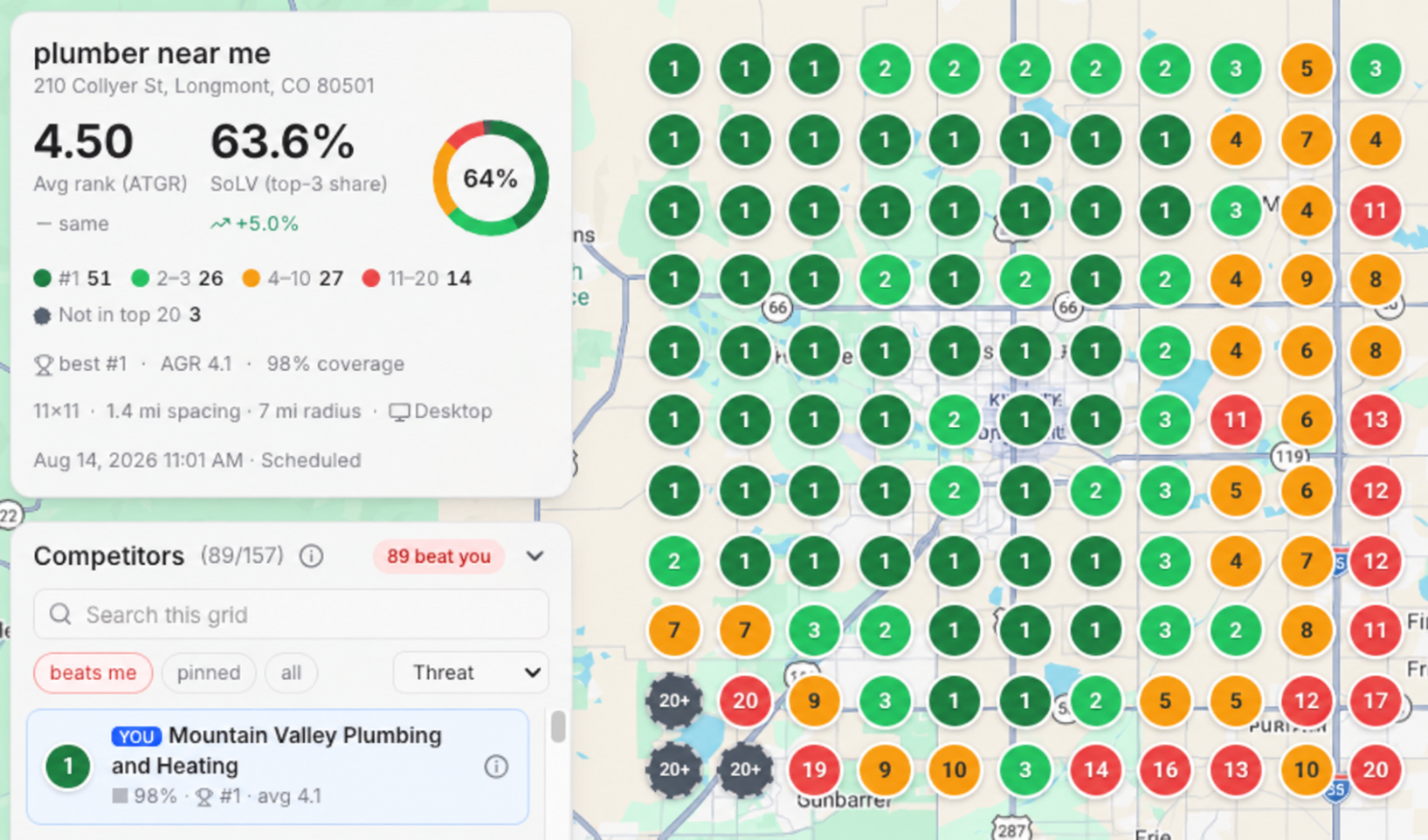
Mountain Valley Plumbing and Heating“plumber near me” · Longmont, CO · edited markers
Edited Mountain Valley Plumbing and Heating geogrid: 4.50 average rank and 63.6% top-three share for plumber near me, August 14, 2026.
63.6%Top-three share · August 14, 2026
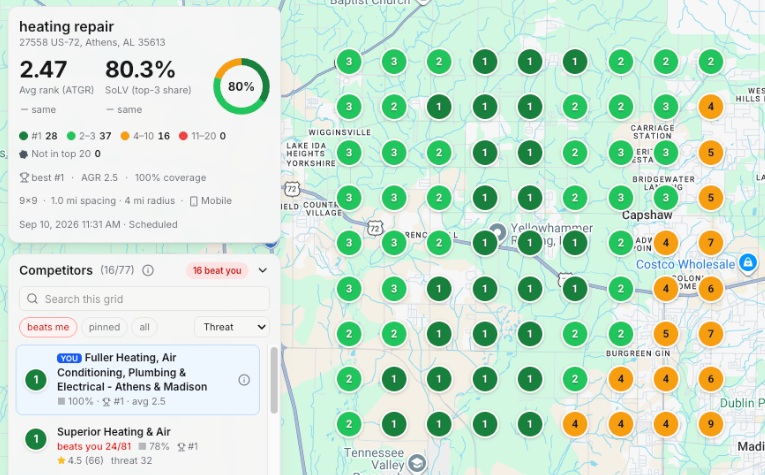
Fuller Heating, Air Conditioning, Plumbing & Electrical“heating repair” · Athens, AL
Fuller heating repair geogrid: 2.47 average rank and 80.3% top-three share, September 10, 2026.
80.3%Top-three share · September 10, 2026

Why Your Ranking Changes Street by Street

Geogrid tracking measures visibility from multiple points across a market instead of reporting one ranking from a single address. It produces a neighborhood-level picture of where a contractor appears in the Map Pack and where the listing drops out of view.

  1. The pattern often identifies the real problem. Visibility may fall too quickly from an operational base. A cluster of weak neighborhoods may point to a service page that does not match local search intent. Strong visibility in one part of the market and none in an adjacent area usually reflects a gap in local signals, not just proximity.
  2. That diagnosis directs the work. An HVAC company may need service-area pages that support its local search strategy. Plumbing and electrical contractors face the same structure. Geogrid data tells you where to build, not just where you stand.
An Elevated Audience strategist working on a client's Google Business Profile

What Actually Moves the Needle for Your Google Business Profile

A Google Business Profile is not a set-it-and-forget-it listing. It is the entity record Google checks against your website, service footprint, and real-world operations. When the phone number, hours, address or service area, categories, and services are out of sync with the website, Google has less confidence placing you in local results.

  1. Ownership and access

    The foundation starts with ownership and access. Your company should control primary ownership, with agency access assigned properly instead of relying on a former employee, vendor, or personal Gmail account. If the account ownership is unclear, that is the first thing to fix before any optimization work.

  2. Service configuration

    Service configuration needs the same care. A plumbing company that handles water heaters, drain clearing, and sewer work should represent those services clearly, without adding every trade it might occasionally handle. Accurate scope builds relevance. Broad, vague service lists dilute it.

  3. Photography and duplicate profiles

    Current jobsite photography supports that work. Photos of branded trucks, technicians, completed installs, and real jobs give homeowners a clearer picture of the company behind the listing. Duplicate-profile cleanup matters too. A second listing at an old address or a profile created by a past marketing provider can split customer attention and local signals creating confusion for customers and search engines.

Choosing Categories

Your primary category should reflect the service homeowners are most likely to need right now. For HVAC contractors, HVAC contractor should rarely be the lead category. Use air conditioning repair service during cooling season and furnace repair service during heating season. The timing matters. Update too early and you can miss the last heat wave. Update too late and the first cold blast has already arrived. Getting this right takes coordination between seasonality, demand, and the services you want to win.

Secondary categories can support real service lines. An HVAC contractor that provides air duct cleaning or commercial work may have appropriate supporting categories. Adding unrelated categories to capture more searches tends to confuse Google and dilute the profile's core relevance signal.

Category decisions also need to match the website. If the profile presents a contractor as a plumber but the site has one thin plumbing page surrounded by unrelated services, Google receives conflicting information. Category and content need to tell the same story about the same business.
Service Areas and the No-Address Problem

Whenever possible, home service businesses should have a public address. A visible location opens up more opportunities to appear in nearby and “near me” searches. Without one, near-me visibility can be very thin or nonexistent.

Service areas should be realistic. Cities, ZIP codes, and coverage boundaries need to reflect where crews can consistently take work, not every municipality within a two-hour drive. Broad service areas weaken relevance in the markets that matter most.

A public address works best when it reflects a real operating base and the markets crews can consistently serve. Keep service areas and website location coverage aligned with those same markets.

Get A Free SEO Analysis in Under 60 Seconds

Instant SEO Report Worth $500 Yours Free

Your instant report reveals:

  • Your exact SEO score vs. competitors in your market
  • Critical technical errors hurting your rankings right now
  • Local SEO opportunities you’re missing
  • Mobile performance issues costing you mobile customers
  • Page speed problems driving visitors away
  • Keyword gaps where competitors are beating you

Enter your website below and get an instant, comprehensive SEO analysis that most agencies charge $500+ to create. Our advanced system scans 200+ ranking factors and delivers a professional report in under 60 seconds.

  • Instant delivery
  • No waiting
  • 200+ ranking factors analyzed

Citations and NAP Consistency in 2026

NAP consistency means keeping your business name, address or service-area configuration, phone number, website, and core details aligned wherever Google and homeowners find them. That includes your website, your Google Business Profile, Apple Maps, Yelp, Bing Places, Angi, HomeAdvisor, and trade-relevant directories.

A local citations service should not mean submitting to hundreds of low-value directories. More listings do not fix conflicting information. An old phone number on a major platform, duplicate profiles under former business names, or a former address still showing on data aggregators can work against a strong profile.

The work follows a practical order:

  1. Establish the canonical business record on the website and Google Business Profile
  2. Audit priority consumer platforms and trade-relevant directories
  3. Correct duplicate, legacy, and mismatched records
  4. Address upstream sources such as Data Axle and Foursquare, where inaccurate details can spread to other directories

For a single-location contractor, the focus is one verified identity and a realistic service footprint. Multi-location companies need accurate records for every office or eligible service-area operation. Manual cleanup is usually the right method for priority listings and stubborn duplicates.

Book a Strategy Call

What NAP Consistency Still Buys You

Clean entity data reduces ambiguity. Matching details help Google connect your website, profile, reviews, and directory mentions to the same business. It also prevents homeowners from calling a disconnected number, finding hours that no longer apply, or landing on a former address.

An audit should separate valid records from listings that only look similar. Former business names, old addresses, improperly used call-tracking numbers, and duplicate map listings can undermine a strong Google Business Profile or location-page strategy. The goal is not directory volume. The goal is one clean, consistent business record that Google and homeowners can trust.

Once entity data is clean, the website needs service and location architecture that supports visibility beyond one immediate neighborhood.

Service Pages and Location Pages Have Different Jobs

A service page proves you understand the work. A location page proves you can credibly perform that work in a specific market. Contractors need both, but they do different jobs.

Service Pages

Your water heater repair, AC installation, panel upgrade, or drain cleaning pages should explain the service, the problems it solves, and why a homeowner should call your company. A city page needs to establish a real connection between your operation and that market. It should reflect how you serve those customers, what work looks like there, and why the listing belongs in local results.

Location Pages

A defensible location page includes useful local context, realistic response expectations, and internal links to the services homeowners in that city request. Where available, it can reference local project experience, technician coverage, review patterns, or operational details that support the business claim.

No Shortcuts

Copying one paragraph across 40 city pages does not create market presence. It creates 40 weak pages that give Google and homeowners very little reason to trust the listing. Effective local SEO for home services builds depth where your business has the capacity and evidence to compete.

How Many Cities You Can Realistically Win

The right number of cities depends on operations first, then search opportunity. Start with the distance from your operating base and the areas your technicians already cover consistently. Then assess demand, local competition, existing reviews and project history, and whether you can produce a location page that actually reflects your presence there.

  1. A contractor with strong crews, steady jobs, and recognizable local signals in three nearby cities can build meaningful visibility there. The same contractor will struggle across 25 towns where they have no jobs, no reviews, no local awareness, and no practical way to reach customers quickly.
  2. Concentrated coverage beats unsupported city lists. The target is not every city on a map. It is the group of markets you can serve, substantiate, and convert into profitable work. Build depth around the core market first, then add cities as technician capacity, local proof, and real demand support the next step.
An Elevated Audience strategist on a call about a contractor's market coverage

Multi-Location Contractors

Separate physical locations can support separate local strategies, but each location needs its own operational record. That includes accurate business information, location-specific pages, appropriate profiles, local evidence, and a clear connection to the crews or staff serving that market.

A virtual office, mailbox, or borrowed address is not a substitute for a real location. It may create a listing problem before it creates any ranking opportunity. A legitimate second location has staff, operational accountability, and a service footprint that can be supported with independent local evidence.

The goal is to publish pages that match the business you actually run, then expand coverage as capacity and proof catch up.

Reviews and the Map Pack

Review signals are part of how Google evaluates local prominence. Review count, recency, and response patterns all factor into how the Map Pack ranks competing businesses for a given search. A contractor with 200 reviews and steady recent activity typically outperforms a competitor with 30 reviews from two years ago, all else being equal.

  1. This applies specifically to the map pack ranking dynamic, not to review management as a service. Profile, categories, posts, and citations live on this page. For a full review generation and reputation management system, see our reputation management service.
  2. What matters here is that review velocity and quality are not separate from local SEO. They are local SEO. A complete local strategy accounts for review signals alongside profile configuration, citation health, and page architecture.

Local SEO vs Organic SEO and Why You Need Both

Google Maps and the Map Pack capture location-sensitive searches. Organic search strengthens the service pages, location pages, and buying-stage content homeowners use before deciding who to call. Contractors need both because customers do not follow one clean path from search to booked job.

A homeowner may first see an ad for emergency plumbing, compare three businesses in the Map Pack, read reviews on a Google Business Profile, then visit a water heater repair page before calling. For a larger job, they may spend days comparing installation options, warranties, and contractor credentials before reaching out.

Local SEO

The local layer centers on Google Business Profile management, accurate citations, market relevance, and measurement that accounts for proximity. It answers a narrow but valuable question: can Google confidently recommend this company to a homeowner searching from this part of the market?

Organic SEO

The organic layer builds a different set of assets. It requires clear service-page architecture, technical SEO, useful content for people comparing options, and enough authority for Google to treat the site as a credible result. Maps visibility earns the click. The website still needs to explain the service, establish trust, and turn interest into a call or estimate request.

Paid search and Local Services Ads can fill demand gaps while owned assets gain traction. A focused Local Services Ads program can place a contractor in front of active demand quickly, while broader SEO work builds coverage that compounds over time.

How Elevated Audience Runs Local SEO as a Revenue System

Local search work should be measured against booked jobs and closed revenue, not a monthly list of posts, backlinks, and ranking screenshots. A ranking matters when it brings the right homeowner to your business, your office answers the call, and the job gets sold.

Elevated Audience runs connected workstreams in phases. Profile alignment, citation cleanup, technical and on-page improvements, service and location pages, and local authority work support the same goal: stronger visibility in the markets and service lines that produce profitable work.

  1. Months One and Two: Fix the Foundation

    The first phase addresses issues limiting visibility now. We align your Google Business Profile, website, service areas, and core business information, clean up conflicting citations, correct crawlability and indexation problems, and improve the pages tied to your priority services. Geogrid reporting shows where Maps visibility is strong and where it falls off by neighborhood, directing the next round of work toward areas where your crews can serve and demand exists.

  2. Months Three Through Six: Build Market Coverage

    Once the foundation is in place, the program expands into market penetration. We produce service and location pages for the work you want more of and the cities your team can consistently cover. Internal linking, schema markup, on-page improvements, and profile work reinforce those pages. The reporting stays tied to calls, forms, and lead quality, not keyword movement alone.

  3. Month Six and Beyond: Compounding Visibility

    After the core service and market structure is built, additional pages and authority signals strengthen the assets already in place. A Philadelphia junk removal client saw a 549% increase in goal completions, a 1,417% increase in organic visitors, and 4,202% growth in ranking keywords within one year. Results like that come from a compounding asset base, not a monthly reset.

SALT Service Co.Google Business Profile
$2,000 / month

July 2026

118.01xROI

Revenue
$236,011
Leads
272
Sold
86

August 2026

105.07xROI

Revenue
$210,132
Leads
289
Sold
85

Two months of one client's Google Business Profile program, from their own reporting. Results vary by market, budget, capacity, and follow-up.

Call tracking and CRM integration connect sources to lead quality, booking outcomes, and closed revenue. Your Google accounts, analytics, website assets, and core data remain in your company's name. Elevated Audience puts the commitment in writing: qualified leads within 60 days or the next month is free. The agency works with one contractor per primary market.

Request a Strategy Call
An Elevated Audience strategist reviewing a contractor's booked-job reporting

Frequently Asked Questions

Can my home service business rank outside its immediate service area?

Yes, but reach is not created by adding a long city list to your profile or website. Visibility outside your immediate area depends on proximity to the searcher, service relevance, local competition, actual technician coverage, and the evidence supporting that coverage across your profile, website, and directory listings. Local SEO for home services works best when the market plan matches real operations.

Will hiding my address hurt Map Pack rankings?

Whenever possible, use a public address. A visible location creates more opportunities to appear in nearby and “near me” searches. Without one, near-me visibility can be very thin or nonexistent. Keep the address, service areas, and website location coverage aligned with the markets your crews can consistently serve.

How long does local SEO take for HVAC, plumbing, or electrical contractors?

Most campaigns begin with foundation work in months one and two, followed by market penetration from months three through six. The first phase fixes profile, technical, citation, and page-level issues that may be limiting visibility now. Some improvement can appear early, but meaningful coverage takes months to build and verify. After six months, the focus shifts to expanding profitable service and location coverage while strengthening assets already in place.

Do I need a local citations service in 2026?

You need accurate core listings, duplicate cleanup, and consistent upstream business data. You do not need hundreds of low-value directory submissions that create more records to maintain. The priority is making sure homeowners and search engines find the same correct name, phone number, website, and service area everywhere they look. Start with Google, major consumer platforms, trade-relevant directories, and data sources that feed other listings.

Should I use one page for every city I serve?

Only publish a city page when you can make a credible case for serving that market. Each page should offer useful local context, reflect the services residents request, match realistic response expectations, and connect to the relevant service pages. Swapping city names across dozens of identical pages creates content Google and homeowners cannot trust. A focused plan for the cities where you have crews, jobs, capacity, and demand will outperform a page count built around every town on a map.

What does a Google Business Profile optimization service include?

A proper google business profile optimization service covers category strategy, service setup, realistic service-area configuration, ownership and access checks, duplicate review, ongoing profile maintenance, website alignment, and measurement of calls and lead quality. It should connect the listing to the services and markets that produce real revenue, not just improve profile completeness scores.

See Where Your Map Pack Visibility Drops Off

Local SEO for home services is a long-term asset that compounds when the foundation is right. The contractors who build real visibility in their core markets, configure their profiles accurately, and maintain consistent business data across the web end up with coverage that a lead marketplace subscription cannot match. Start with a market review.