

Book a Strategy Call

HVAC Marketing Agency for Contractors Who Want Booked, Profitable Jobs

A full board in a heat wave can hide a weak demand system. Shoulder season exposes it.

Elevated Audience helps HVAC owners build demand they own, matching seasonal plans to crew capacity, job mix, and the service lines that protect margins year-round.

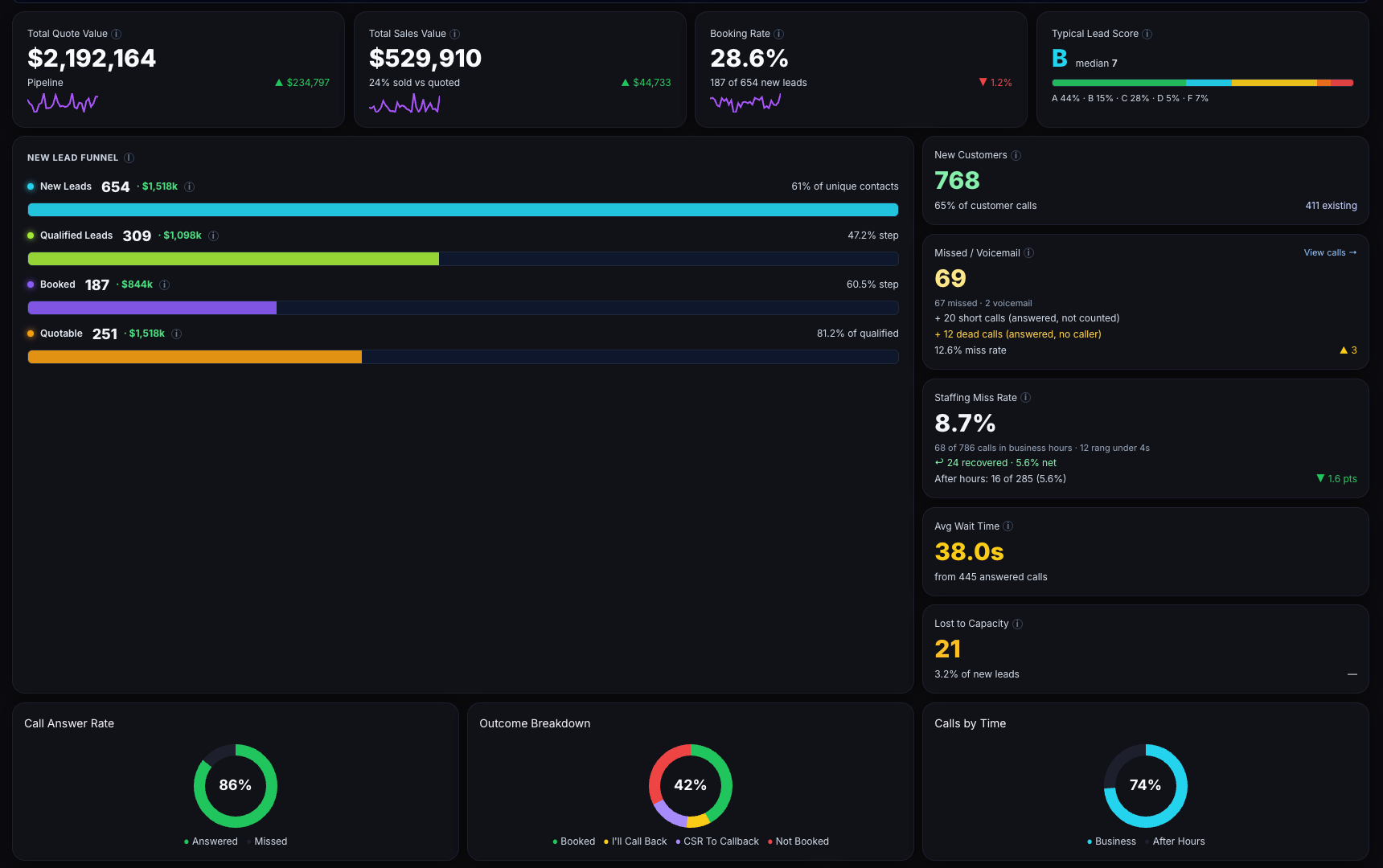
Inbound Intel AI dashboard showing: total quote value, total sales value and conversion rate above a new-lead funnel from new leads to qualified, booked and quotable, with missed-call and staffing cards beside it
Inbound Intel AI · lead funnel and booking outcomes

More than $80M in annual revenue generated for our home service clients. We connect calls and leads to closed revenue, so you can see which campaigns produce booked, profitable jobs.

Google Partner badgeGoogle Partner: Google Ads certified

Your HVAC Marketing Plan Must Account for Demand, Capacity, and Job Mix

A strong HVAC marketing plan keeps work moving before and after peak demand by planning for the jobs, markets, and capacity your company can profitably serve.

A full July board can hide an unhealthy demand system. Your technicians may be overloaded with emergency cooling calls in summer, then underutilized in spring and fall. Maintenance opportunities sit unclaimed, replacement estimates go cold, and past customers do not hear from you until their next breakdown.

That is a business reacting to weather, not planning revenue.

More leads will not fix it alone. Your plan must match the work you want, the crews you can dispatch, and the markets you can cover without lowering response standards.

An Elevated Audience strategist at a desk planning an HVAC client's seasonal demand across two screens

Seasonal Planning Keeps the Shoulder Season From Becoming a Payroll Problem

Cooling emergencies, heating emergencies, and changeover maintenance do not need the same message or budget all year. Homeowners search differently when temperatures spike than they do during a mild October week.

Summer campaigns should prioritize high-intent AC repair and replacement demand when your team can serve it. Heating campaigns should take over as the season changes. Spring and fall create a different opening for maintenance agreements, tune-ups, estimate follow-up, and past-customer reactivation.

The goal is not to force demand where it does not exist. It is to give homeowners a relevant reason to call before emergency demand takes over again.

A seasonal plan also protects your replacement pipeline. A homeowner who requested an estimate but did not move forward may need financing information, a timely follow-up, or a reminder before the next weather swing. That work belongs in the calendar.

Capacity Should Set the Pace of Your Lead Generation

Marketing should reflect available technicians, service radius, response standards, and your office team's ability to answer and book calls. If dispatch is full, paying for more same-day repair calls creates a customer experience problem.

If calls go unanswered, marketing cannot repair it.

The same applies when a CSR takes too long to return a missed call or does not follow up on web leads. You may have a lead quality problem, an office process problem, or both. They require different fixes.

Elevated Audience uses Inbound Intel AI to review inbound calls, forms, and Local Services Ad leads. It separates real opportunities from spam, existing-customer calls, and wrong-service-area contacts. It also shows whether calls were booked, missed, or lost during the conversation.

That gives you more than a call-volume report. You can decide whether to increase demand, tighten the service area, improve call handling, or shift budget to a service line your team can actually sell.

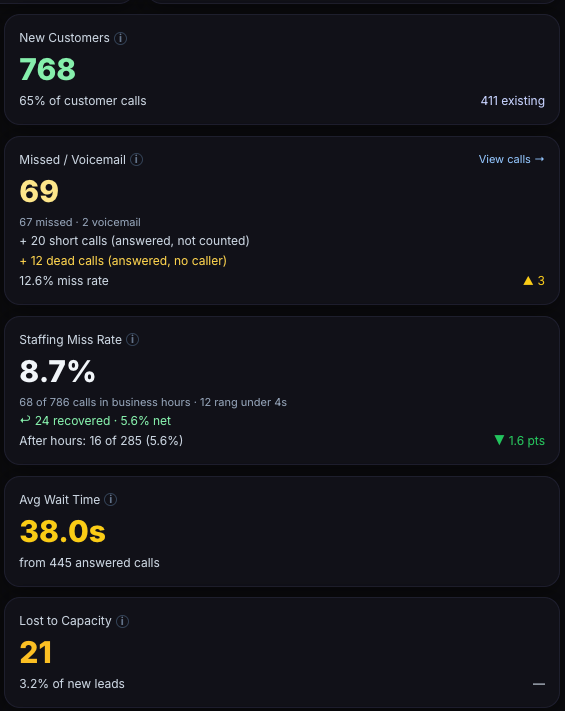
Inbound Intel AI capacity cards showing: new customers, missed and voicemail calls with the miss rate, staffing miss rate in business hours and after hours, average wait time, and leads lost to capacity
Inbound Intel AI · missed calls, staffing and lost-to-capacity

Job Mix Determines Whether More Calls Create More Profit

A repair call, maintenance opportunity, replacement estimate, and membership sale do not have the same value to your company. They also do not need the same marketing message, landing page, follow-up process, or budget.

Some contractors need more booked repair work to keep crews productive. Others have enough repair volume but need more replacement opportunities. A company building recurring revenue may need more membership sales and a clear process for technicians to present them during service visits.

Your agency needs to understand which work supports your growth goal. That starts with average job value, if you track it, plus close rate and capacity by service line.

Buying volume without a planPlanning demand around profitable work
Pays for every available callPrioritizes the service lines you want to grow
Keeps ads running after dispatch fillsAdjusts demand to available crews and response times
Measures call countMeasures booked jobs and closed revenue
Treats every lead the sameSeparates repair, replacement, maintenance, and membership opportunities

Each Service Area Needs Its Own Demand Plan

A multi-market HVAC company cannot treat every zip code as identical. One market may have strong brand recognition and a healthy Google Business Profile. Another may need more paid coverage, more local service pages, or a tighter service radius because travel time cuts into profit.

Market count matters because your team, budget, competition, and response capacity can differ by location. A replacement campaign that works in one city may not be the right move in the next.

Broad reports fall short here. You need to know which market produces booked jobs, which service lines convert, and where your office can support more demand. Closed revenue is the scorecard. Traffic, impressions, and rankings help diagnose the work, but they do not pay payroll.

The first strategy call should review your service lines, average job value if you have it, close rate, seasonality, market count, and current capacity. That creates the calendar plan before anyone selects channels or raises ad spend.

HVAC Digital Marketing Works as One Revenue System

HVAC digital marketing works when every channel feeds one demand system that creates, captures, follows up on, and measures profitable opportunities.

The measurement layer comes first because it shows where the problem sits. Inbound Intel AI, built on CallRail, analyzes inbound calls, web forms, and Local Services Ad leads for lead quality, booking outcome, missed-call recovery, and CSR performance.

Your field service CRM remains the authority for closed revenue. ServiceTitan, Housecall Pro, or a comparable system records quoted value, sold value, job type, and final status after a lead leaves the marketing system.

Together, the systems show whether marketing failed or the front desk lost the call.

Build Demand You Own Before You Need It

Owned demand starts with the pages, local visibility, and reputation your company controls. That includes service page architecture and HVAC SEO, local SEO, Google Business Profile work, review generation, and a conversion-focused website.

Each part has a job. Service pages target the repairs, replacements, maintenance plans, and markets you want to grow. Local visibility helps homeowners find the right location. Reviews help support the trust decision before the call.

SEO is like buying land. You invest in property, improve it over time, and build an asset your company owns. A useful service page can continue earning search visibility after the work to create it is done.

Google Ads is like renting. You pay for access to high-intent searches, and lead flow can stop when the budget stops or a payment method fails.

Both belong in the same system. Paid search can cover immediate demand while your owned search presence grows. Your service pages, local visibility, reviews, and website do not reset every month.

Capture the Right Work Through Paid Search

Google Ads and Local Services Ads should bring in work your company can book and profitably serve. Raw click volume is not the goal. Neither is a low cost per lead if calls fall outside your service area, involve work you do not want, or exceed your office capacity.

Campaign structure should reflect the parts of your business that matter:

  • High-intent repair, replacement, maintenance, and membership searches
  • Seasonal demand shifts and current weather conditions
  • Service areas your technicians can cover efficiently
  • Job types that support your target ticket and margin
  • Available dispatch and CSR capacity

Local Services Ads need active lead quality management. Review job types, service areas, missed-call patterns, booking outcomes, and disputed leads. An LSA account left on autopilot can become another source of unqualified calls.

Google Ads needs the same discipline. Search terms, negative keywords, ad copy, landing pages, and budgets should support the service lines you want more of. A replacement campaign should not send traffic to a generic homepage.

Cost per lead is a diagnostic. Cost per booked job and closed revenue show whether a channel deserves more budget.

Convert and Follow Up on Opportunities That Do Not Book Immediately

Most HVAC opportunities do not follow a clean path from search to booked job. A homeowner may compare companies, request a replacement estimate, leave after reading financing details, or submit a form after business hours.

Conversion work continues after the first visit. Landing page message match keeps the page aligned with the search or ad that brought the visitor there. Call handling visibility shows whether a real opportunity received a proper response. Remarketing, database reactivation, email, and reputation work keep your company visible when a homeowner is not ready to book.

Missed leads need a defined recovery process. The system should show whether a caller was recovered within 24 hours. Estimate follow-up should reflect the service type and likely value of the opportunity.

Instant Estimator AI is a client-exclusive tool that captures visitors who might otherwise leave without contacting you. It provides a preliminary estimate based on service needs and project details, then routes the lead by service line and project value.

After installation, Instant Estimator AI lifted conversion rates 40% to 60%.

A lead that does not book today is not automatically a bad lead. It may need a faster response, clearer information, or a follow-up process that does not depend on someone remembering to make the call.

Run the Business From an Operating Scorecard

Your scorecard should connect marketing activity to what your company sold. Track qualified leads, cost per booked job, job type, quoted value, sold value, close rate, and closed revenue.

This gives you an operating view of the business. You can see whether a campaign produces repair calls that book, replacement opportunities that become estimates, or leads your team repeatedly loses before dispatch.

Impressions, sessions, rankings, and raw calls are diagnostics, not the outcome.

A report should help you make a decision. It should show which source produced closed jobs, which job types were sold, and where the process broke when results fell short.

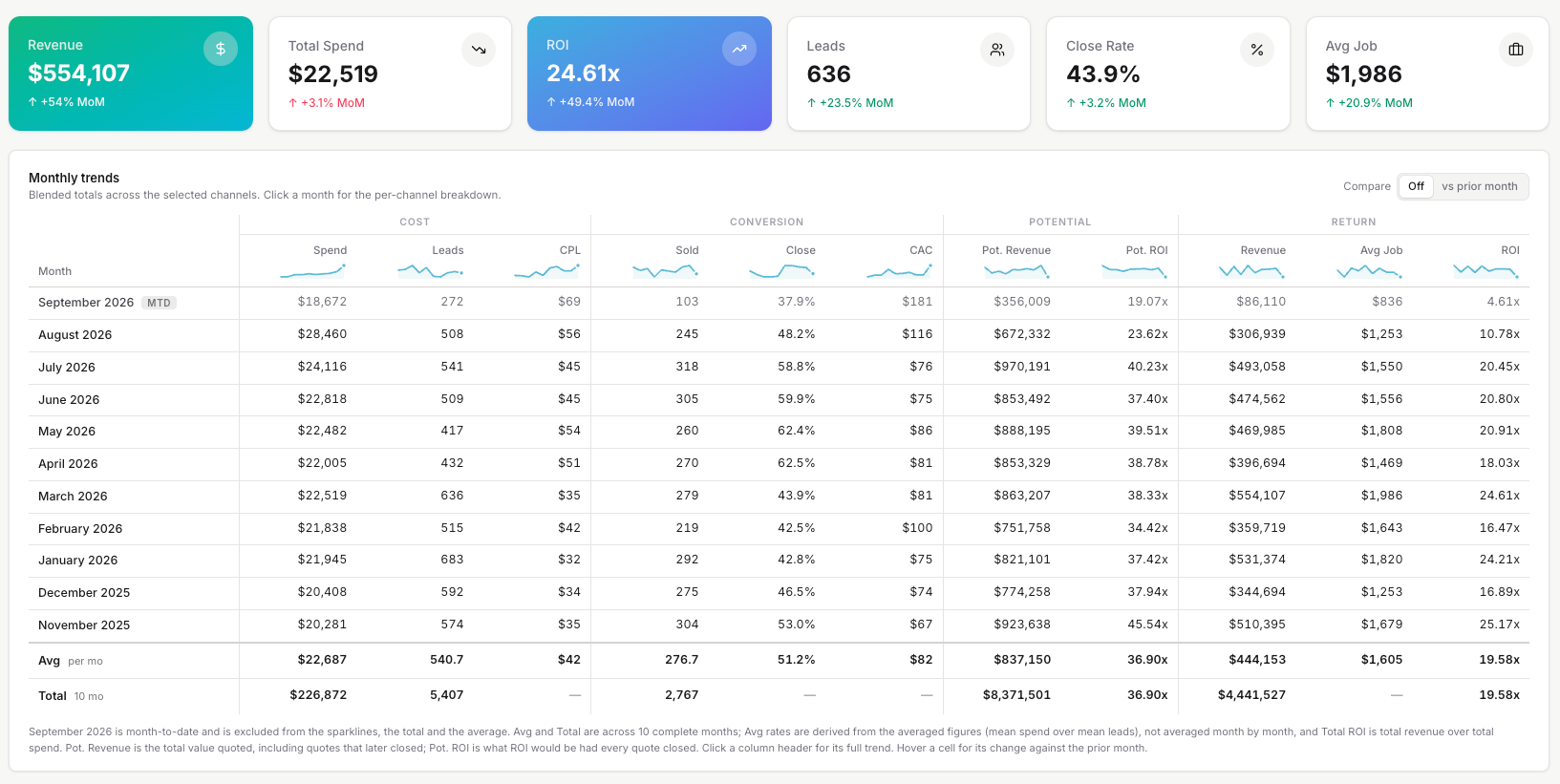
Elevated Engine KPI dashboard connecting marketing spend, leads, closed revenue, close rate and ROI across monthly trends
Elevated Engine · operating scorecard and monthly ROI · View full size

Revenue Attribution Connects Marketing Spend to Closed HVAC Jobs

Revenue attribution means matching the leads marketing created to the jobs your company actually sold. It does not mean reporting calls, form fills, and website traffic, then hoping those leads became revenue.

Fuller Services

Fuller Services is an HVAC, plumbing, and electrical contractor serving Muscle Shoals and Athens, Alabama. From November 2025 to August 2026, its whole marketing program generated $4.41M in tracked closed sales on $163k in ad spend. That is a 27x return on ad spend.

Fuller Services whole-program resultMeasured outcome
Tracking windowNovember 2025 to August 2026
Tracked closed sales$4.41M
Ad spend$163k
Return on ad spend27x
Return including program fees19x
Jobs sold2,761
Average job value$1,597
Lead-to-sale close rate51%

The headline result covers the whole program. It does not mean SEO, Google Ads, Local Services Ads, or web design alone produced $4.41M in sales.

Tracked closed sales are ServiceTitan closed-job value matched to the originating lead through Inbound Intel and attributed to first touch. Ad spend excludes program fees, while the 19x return includes them.

Fuller Services Case Study

SALT Service Co., a plumbing, HVAC, and electrical contractor in Greater Austin, generated $5.56M in tracked closed sales on $948k in ad spend over 12 months (September 2025 to August 2026), a 5.9x return on ad spend. Scope: Google Ads, Local Services Ads, and Google Business Profile only.

A call can look like a win in an agency dashboard and still never become a booked job. Revenue attribution follows the outcome far enough to show the difference.

"Working with Jared and the Elevated team has been a total game-changer for our growth. We just landed a $38,000 project from one of our campaigns, and we're still just getting started. Highly recommend their strategy and support!"
Jaime Mendoza, A-C Air Care, HVAC, Elkridge, MD

Why Closed-Job Data Changes the Decisions You Make

You cannot manage a marketing budget from call volume alone. You need to know which sources create profitable jobs, which service categories deserve more capacity, and where good opportunities are being lost.

Inbound Intel identifies the originating source and records what happened when the lead came in. ServiceTitan records the outcome after your office books the work, dispatch sends the technician, and the estimate is sold or lost.

That turns marketing reporting into an operations report.

If Google Ads drives replacement estimates that close, you can put more budget behind that campaign. If Local Services Ads produce calls your CSRs cannot book, you can review the calls before increasing spend. If maintenance leads book but never convert into memberships, that is a sales-process issue, not an SEO issue.

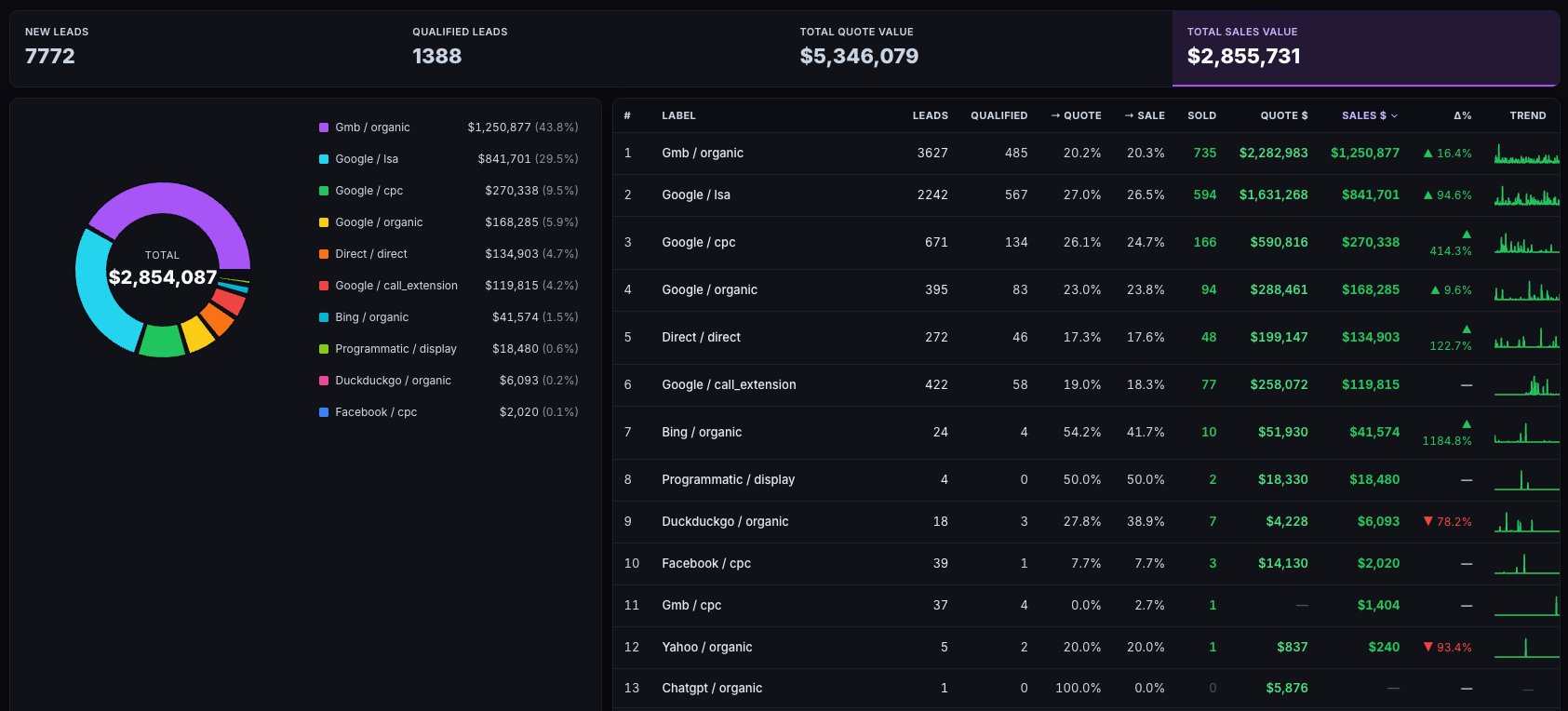
Inbound Intel AI source attribution showing qualified leads, quoted value and closed sales by marketing source
Inbound Intel AI · source-by-source revenue attribution · View full size

The Report Should Show Where the Leak Happened

A useful report lets you trace a lead from the first call or form submission to the closed job. It should also show where the path broke.

You should be able to separate four situations:

  1. Marketing did not generate enough qualified opportunities.
  2. The office did not answer, return, or book the opportunity.
  3. Dispatch or service-area limits prevented the job from moving forward.
  4. The estimate did not close after the technician arrived.

Without that connection, an agency can blame your office for weak results, and your office can blame lead quality. Both may be right. Neither can prove it without call data and closed-job data in the same view.

First-touch attribution gives credit to the source that started the relationship, even if the homeowner returns through another path before the job sells.

Elevated Audience has generated more than $80M in annual revenue for home service clients. The goal is to give you enough visibility to make better decisions about budget, capacity, service mix, and call handling.

HVAC Marketing Pricing and Who This Partnership Is For

HVAC marketing starts at$2,495per month.There is no setup fee and no contract. Every program is month to month.

Ad spend is separate from the program investment. It stays in your own Google and Meta accounts, so you can see what the platforms charge and keep control of the accounts.

That is the starting point, not a one-size-fits-all package. Your scope reflects your market, operational capacity, and the growth goal you need marketing to support.

What changes the investment

  1. Your growth goals and the gap we need to close.
  2. How many primary markets you want to own and the size of your service area.
  3. Which channels: Google LSA and Google Ads, or Meta Ads on top.
  4. The number of Google Business Profiles you own.
  5. Your appetite for aggressive or sustained growth.

What Changes Your Marketing Investment

Your investment depends on the gap between where the business is now and where you want it to go. One company may need steadier shoulder-season demand in a single service area. Another may be adding replacement volume across several markets.

Each market has its own search demand, competition, local visibility, and dispatch limitations. Multiple Google Business Profiles also need individual attention. One location may consistently produce booked jobs while another needs stronger local coverage before additional ad spend makes sense.

Channel mix matters for the same reason. Google Local Services Ads and Google Ads capture homeowners actively searching for repair, replacement, or maintenance. Meta Ads can support financing offers, stay visible to past customers, or build demand before a weather shift. Not every HVAC company needs every channel at once.

Multi-location groups and businesses above $15M receive a custom scope based on their markets, service lines, and existing systems.

This Works Best for Owners Ready to Connect Marketing to Operations

The primary fit is an HVAC owner at $2M or more in annual revenue who is no longer in the field every day. You have crews, office staff, and enough moving parts that a ringing phone is not a useful marketing report.

You need to know what happened after it rang.

That means tracking which channel produced the lead, whether your front desk answered, whether the caller booked, and whether the job became closed revenue. You may use ServiceTitan, Housecall Pro, or another field service CRM.

Elevated Audience also serves growth-committed contractors from $750k in annual revenue. You may still be close to daily operations at that stage, but you still need a repeatable way to create demand, track it, and improve it before the business outgrows guesswork.

This is not a fit if you do not answer the phone, do not call people back, or are not committed to growth. That is not a judgment. It is an operational reality.

Marketing cannot turn unreturned calls into booked jobs.

Paid search can produce a qualified repair call. Local visibility can help a homeowner find you. A stronger website can make it easier to request service. None of it helps if the caller reaches voicemail, the form sits unanswered, or estimate follow-up never happens.

Jared Tangir, founder of Elevated Audience, at his desk in the Doylestown office

When Another Option May Make More Sense

A contractor without the operational capacity for more demand may need to fix call handling, dispatch, staffing, or the sales process before increasing acquisition. More leads create pressure if your office cannot answer them or your technicians cannot serve them promptly.

Start by finding the bottleneck. That may mean reviewing missed calls, setting callback standards, tightening the service area, improving estimate follow-up, or hiring for a clear gap in the office or field.

You also may not need a full revenue attribution partner if you only want a one-time website or an unmeasured, low-cost vendor for a limited project.

Lower-priced providers are not automatically dishonest. Cheap marketing fails when limited resources force low-quality strategy or shortcuts. A provider cannot give every market, service line, ad account, and conversion problem the attention it needs while charging for only a fraction of the work.

On Grow and Scale, we will not take a competing contractor in your primary zip code for as long as you are with us.

You Keep Your Accounts, Data, and Marketing Assets

You own everything: your website, analytics, Search Console, ad accounts, call data, and every asset we produce.

That matters if you have ever ended an agency relationship and lost access to a domain, Google Ads account, website login, or years of historical reporting. Those assets represent work your company paid for. They should stay with your business whether you continue working with us or not.

Your accounts remain in your name. Your ad spend stays in your own Google and Meta accounts. If you decide to leave, you keep the website, campaign history, tracking data, and materials built for your company.

A marketing partner should earn your business through results, not by making it difficult to leave.

Switch Agencies Without Starting From Zero

A change in agencies does not require throwing out everything the previous team touched. Some service pages may have useful history. Certain campaigns may produce qualified calls. Your existing tracking, local visibility, and website content may provide a solid starting point.

We first look at what worked, what did not, and which immediate actions can produce high-quality leads that convert into sales as quickly as possible. Then we decide what to repurpose and what to prune.

The transition starts with an audit of account access, tracking, service pages, local visibility, conversion paths, and active paid campaigns. That audit creates an order of operations based on your current demand gaps, not a generic launch checklist.

A paid campaign that produces booked repair calls may need refinement, not replacement. A generic page that sends replacement traffic to a contact form may need a clearer message and conversion path. Broken tracking needs attention before anyone makes claims about channel performance.

Reports Should Lead to Decisions

A report should show qualified leads, booking outcomes, cost per booked job, quoted and sold value, closed revenue, and channel performance. That gives you an operating scorecard, not a stack of screenshots.

Inbound Intel AI shows lead quality, call outcomes, missed calls, and CSR performance. Your field service CRM confirms what happened after the call, including whether the opportunity became a quoted job, a sold job, or closed revenue.

A chart cannot tell you whether an ad failed or your front desk lost the call.

This matters when results fall short. If a campaign generates qualified replacement opportunities but calls are missed or not booked, the fix belongs in call handling. If calls are booked but estimates are not sold, the problem may sit with pricing, technician presentation, financing, or follow-up.

Closed revenue remains the final scorecard. Leads, calls, rankings, and traffic help diagnose performance, but they do not tell you whether marketing produced profitable work until they connect to jobs your company sold.

Honest SEO Timelines Start With the Foundation

SEO is a compounding channel, but it is not an overnight fix for a weak site or an unreturned phone call. The first work focuses on getting the foundation right, then building coverage and authority over time.

PhasePrimary work
Days 1 to 90Tracking, technical fixes, priority service pages, and foundational work
Days 90 to 180Sustained publishing, authority building, and broader visibility
Days 180 to 365Compounding can become more visible as the work builds

No honest provider can guarantee a specific ranking by a specific date. The pace depends on your starting site condition, competition, market count, content capacity, and how well your office converts calls into booked jobs.

That is why the first priorities matter. A contractor with broken tracking, thin service pages, and missed calls needs a different sequence than a company with a strong site that needs more local coverage in a second market.

Qualified leads within 60 days or your next month is free. No setup fee. Every program is month to month.

HVAC Marketing Agency FAQs

How much does an HVAC marketing agency cost?

Elevated Audience starts at $2,495 per month, with no setup fee and no contract. Every program is month to month. Ad spend is separate from the program investment and remains in your own Google and Meta accounts.

Your total investment depends on the growth gap you need to close, the number of markets you serve, your Google Business Profiles, your channel mix, and how aggressively you want to grow. The right scope should reflect your capacity to answer, book, and sell the work marketing creates.

What is a qualified HVAC lead?

A qualified HVAC lead is a real opportunity from a person who needs a service you offer and falls within your service area. It should have a reasonable path to becoming a booked job, not simply a phone call or form submission.

Spam, existing-customer contacts, wrong-service-area calls, and inquiries your office never books should not be counted as profitable demand. Raw lead volume can help diagnose performance, but booked jobs and closed revenue are the governing metrics.

Should an HVAC contractor invest in SEO or Google Ads first?

Google Ads can capture active demand now. SEO builds an asset your company owns over time. The right order depends on how quickly you need leads, how competitive your market is, the condition of your website, and whether your team has capacity for more calls.

Think of SEO as buying land. You improve a property your company owns through service pages, local visibility, and conversion work. Google Ads is renting access to high-intent searches. Both can work together, but paid demand should not replace the long-term work of building an owned demand system.

Will I own my website and ad accounts if I work with Elevated Audience?

Yes. You own everything: your website, analytics, Search Console, ad accounts, call data, and every asset we produce. Your company keeps those assets if you ever change agencies or bring marketing in-house.

That ownership also means your Google and Meta ad spend stays visible in accounts you control. You should never have to rebuild campaign history, tracking data, or a website because a marketing relationship ends.

How long does HVAC digital marketing take to produce results?

Paid acquisition and foundational work can begin producing useful information in the first 90 days. That period focuses on tracking, technical fixes, priority service pages, and campaigns that can capture current demand.

From days 90 to 180, sustained publishing, authority building, and broader search coverage can make visibility more consistent and begin building organic leads. From days 180 to 365, the work can compound as more pages earn consistent rankings and conversion improvements apply to a larger traffic base. No honest agency guarantees a specific ranking by a specific date.

Plan Demand Around the Jobs You Want to Book

We will review your current demand system and determine the first priorities for growth.