
How to Get More Plumbing Leads: 8 Channels That Work
Your phone buzzes. You call immediately, but the homeowner already hired another plumber.
That advertised price hides the real cost of losing the job. Understanding how to get more plumbing leads only matters if you generate booked jobs you own, track, and control.
Here are six channels worth building, plus the two systems that book the work.
Start with the channel that looks cheapest upfront but quickly becomes the most expensive.
1. Treat Shared Lead Platforms as a Temporary Crutch
Shared leads can fill a short-term gap on an empty dispatch board, but they should never become the foundation of an established plumbing business. When you look for how to get more plumbing leads, third-party marketplaces look like an easy shortcut.
The marketplace business model is engineered around vendor competition, not contractor margins. A homeowner submits a request for water heater repair or a clogged sewer line. The platform instantly sells that identical request to four or five competing plumbers at the exact same moment.
Emergency plumbing callers book the first company that answers the phone.
If your dispatcher calls back two minutes late, you still pay for the lead while your competitor secures the job. You end up paying for an invoice with zero chance of collecting revenue.
Before spending your marketing budget in these directories, put every platform through a four-part decision test:
-
Cost per booked job, rather than the initial cost per contact
-
True close rate compared to your exclusive inbound calls
-
Service area fit to prevent paying for out-of-territory travel
-
Exclusivity, verifying whether the lead is sold to multiple competitors
There is a narrow scenario where this model functions. A brand-new shop needing fast volume can test a tightly capped marketplace budget to generate initial dispatch opportunities and earn early reviews. If you test this route, log every contact in your CRM and track the true return on investment.
Read our guide on why shared leads cost more than they look for the complete margin and ownership walkthrough.
Shift your marketing budget toward assets where your company owns the website, ad accounts, call data, and customer relationship.
2. Optimize Your Google Business Profile to Win Local Trust Fast
Your Google Business Profile is the fastest owned asset to improve when learning how to get more plumbing leads. Most homeowners evaluate your listing in Google Maps long before they ever click through to your website.
A fully optimized profile converts local searches into exclusive phone calls before competitors even know the homeowner has a leak.
Getting the fundamentals right immediately sets you apart from neglected competitor listings:
-
Set your primary category to "Plumber" and add specific secondary categories for services like drain cleaning and water heater repair.
-
Verify that your direct phone number, website URL, service radius, and operating hours are exact.
-
Upload job photos weekly showing wrapped trucks, uniformed technicians, and high-ticket installations you want to sell.
-
Respond to every review to signal to Google and prospective customers that you run an active shop.
Recent reviews directly dictate lead quality. When a homeowner compares local contractors, they want proof that your team communicates clearly, shows up on time, and solves the problem right the first time.
Build your review collection workflow around real, completed jobs. Have your technicians or CRM send a direct review link by text immediately after finishing work. Never buy reviews. Fake feedback risks account suspension and destroys homeowner trust.
Your profile must serve two different buyer mindsets. An emergency searcher dealing with a slab leak needs verified hours and a click-to-call button. A customer planning a major repipe inspects your photo gallery, service descriptions, and recent customer reviews before scheduling an estimate.
Your listing establishes trust before the click, functioning alongside a broader home services SEO strategy to capture high-intent searches across your entire service territory.
3. Capture Urgent Calls Fast With Google Local Services Ads
Local Services Ads are a strong channel for urgent plumbing demand when your team can answer live, dispatch quickly, and screen calls by service area and job type. If you need to know how to get more plumbing leads during a sudden call slump, this platform provides immediate visibility.
These ad units appear at the very top of Google search results, allowing homeowners to call or message your shop directly. You pay per lead rather than per click. That model protects your budget from empty clicks, but paying for a phone call does not guarantee a profitable job.
Local Services Ads produce high-margin work only when your operational discipline matches the speed of the platform.
Maintain tight control over your account with an active operating checklist:
-
Keep your license, insurance, profile details, service areas, and offered job types accurate.
-
Run ads during live answer coverage, or use an answering process that can book urgent calls immediately.
-
Review every lead, document spam or out-of-area contacts, and use call recordings and job notes when challenging invalid charges.
Separate emergency repair calls from planned replacements. Burst pipes and sewer backups require immediate dispatch, while tankless conversions demand consultative booking. Turn off low-margin jobs that clog your dispatch board, and prioritize the higher-ticket services your team can schedule and fulfill profitably.
Pair this setup with a structured system for PPC for home services to control your total paid search footprint.
Not sure if LSA is the right fit for your market? Get in touch with our team.
4. Rent High-Intent Demand With Google Search Ads
Google Ads creates demand quickly when you target the exact plumbing jobs you want and send each click to a dedicated page. If you need to know how to get more plumbing leads without waiting for organic rankings, paid search gives you immediate control over your dispatch board.
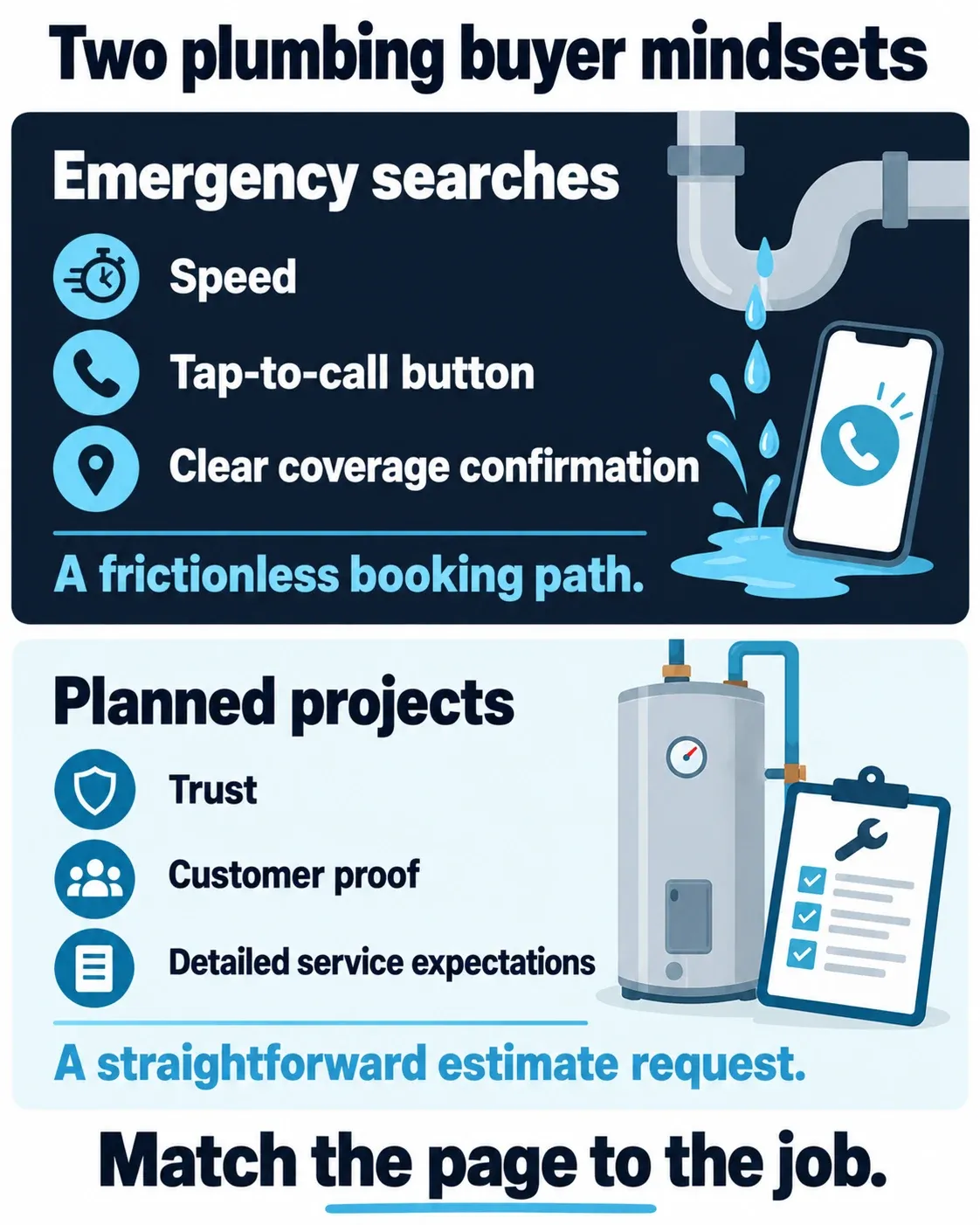
Plumbing prospects arrive on Google in two distinct buying situations.
Emergency searches demand speed. A homeowner dealing with an active water leak needs a tap-to-call button, clear coverage confirmation, and a frictionless booking path.
Planned projects require trust. Higher-ticket work like water heater replacement, sewer repair, whole-home repiping, or filtration requires customer proof, detailed service expectations, and a straightforward estimate request.
Sending both searchers to a generic homepage destroys your conversion rate and wastes ad spend.
Protecting your ad budget requires strict operating discipline:
-
Target tightly matched service and location searches rather than loose, broad traffic.
-
Route every ad group to a dedicated landing page designed specifically for that job.
-
Maintain negative keywords to block unqualified clicks, including DIY repairs, supply houses, trade training, and scrap searches.
Remarketing works well as a supporting tool to re-engage previous visitors who already recognize your company. Never rely on it as a substitute for capturing high-intent search demand.
Google Ads rents immediate attention, but local SEO builds an asset your company owns.
A disciplined paid search strategy captures profitable jobs today, keeping your technicians busy and your trucks rolling while your owned organic rankings compound over time.
5. Build Local SEO as a Compounding Asset
Local SEO creates plumbing leads you do not have to buy back each month. When your website earns organic visibility for the exact services and communities you serve, you build lasting digital equity instead of renting every phone call.
Local SEO gives your plumbing business a compounding customer channel that protects your profit margins over time.
Relying only on paid ads is like renting land. When your budget pauses, your dispatch board clears out. Organic search rankings establish an asset you own.
Turning search traffic into booked calls requires a deliberate site architecture rather than a generic brochure site:
-
Focused service pages for profitable jobs like sewer lining or water heaters, avoiding one page that tries to cover every repair
-
Useful service area pages built around real local relevance, avoiding duplicate cookie-cutter content with only city names swapped
-
Homeowner guides that answer technical questions, helping customers understand their options before scheduling a planned replacement
Your content must also match the homeowner's specific intent.
Emergency pages for burst pipes or clogged drains need clear availability, instant tap-to-call buttons, and local credibility so panicked customers can book right away. Higher-consideration pages for whole-home repiping require scope details, verified reviews, and transparent pricing answers that reduce hesitation before an in-home estimate.
Behind that messaging sits your technical baseline. Your site must offer fast mobile usability, clean crawlable architecture, accurate title tags, and zero thin duplicate pages.
A home services SEO strategy takes months to compound and will not replace paid search when your technicians need calls today. Over time, that foundation produces consistent, exclusive leads that keep your plumbing trucks rolling without paying a broker for every click.
6. Turn Existing Customers and Local Partners into Repeat Plumbing Leads
The most profitable plumbing leads come from people who already know your work or local partners who trust you enough to send the next job your way.
Instead of constantly buying cold clicks, build an operational system around your existing contacts.
Owned relationships generate high-margin work without paying an ad platform for every single conversation.
Start with database reactivation:
-
Segment past customers by service history to send timely water heater flush notices, drain inspection reminders, or seasonal freeze warnings.
-
Follow up on open, unsold estimates with a concrete next step, financing options, or equipment comparisons instead of a generic check-in message.
Referrals should operate as a formal process rather than a happy accident. Have technicians ask for introductions right after completing a five-star job while the homeowner's relief is still fresh.
Then build reciprocal referral networks with non-competing businesses that uncover plumbing work every week:
-
Water damage restoration contractors
-
Property managers
-
Real estate professionals
-
General remodeling contractors
Agree on communication standards and expectations up front. If you decide to offer referral fees or revenue shares, always have legal counsel review the arrangement first.
For hyper-local visibility, maintain an authentic Nextdoor profile. Post helpful neighborhood advice, and only introduce zip-code-specific offers when your dispatch board has genuine capacity for that route.
Treat Meta ads and direct mail as secondary support tools rather than standalone generators. Use Meta to retarget your existing CRM list and website visitors. Send targeted postcards to the immediate radius around a completed repipe or sewer line replacement. Never spend capital on broad, untargeted awareness campaigns.
We apply the same playbook in junk removal and other home services. Owning your customer base beats renting clicks every time.
7. Convert More Inbound Leads by Fixing Website Leaks and Speed to Lead
Buying more traffic will not fix a website that hides your phone number or a front desk that lets urgent callers reach voicemail.
If your intake process is broken, increasing your ad spend only burns cash faster. You might find your site is leaking the leads before they ever reach your phone, but the real breakdown usually spans both your digital layout and your phone handling.
Turn your website into a reliable booking engine with a basic conversion checklist:
-
Tap-to-call buttons and a clear booking path visible across every mobile screen
-
Clear separation between emergency help and planned estimate requests
-
Trust signals, service details, recent reviews, and real team or job photos placed near the decision point
Converting clicks into booked revenue is an operations issue.
When a homeowner has an active leak, speed to lead wins the job. Every missed call gives that customer permission to call the next plumber on Google.
Tighten your intake operations to protect every inbound opportunity:
-
Maintain live answering coverage for urgent demand whenever possible.
-
Set up an automated missed call text back that immediately acknowledges the homeowner and gives them a direct path to reconnect.
-
Review missed calls, voicemails, form submissions, and unsold estimates weekly so no lead source quietly leaks.
When paid leads fail to book, determine whether the marketing traffic was wrong, your website was unclear, or your front desk lost the call.
Those are different business problems. Once you separate operational friction from marketing performance, you stop guessing why the dispatch board is empty.
8. Measure Marketing by Booked Jobs and Closed Revenue
A plumbing lead channel is working only when it produces profitable booked jobs and closed revenue, not when it produces calls, clicks, or a good-looking report.
Traffic, search rankings, and impressions are diagnostics, not business outcomes. They show whether homeowners can find your plumbing company online, but diagnostics never prove that your marketing budget paid the bills.
Track your marketing pipeline against five core numbers:
-
Spend by channel
-
Qualified leads by channel
-
Booked jobs and lead-to-appointment rate
-
Cost per booked job
-
Closed revenue and return on ad spend
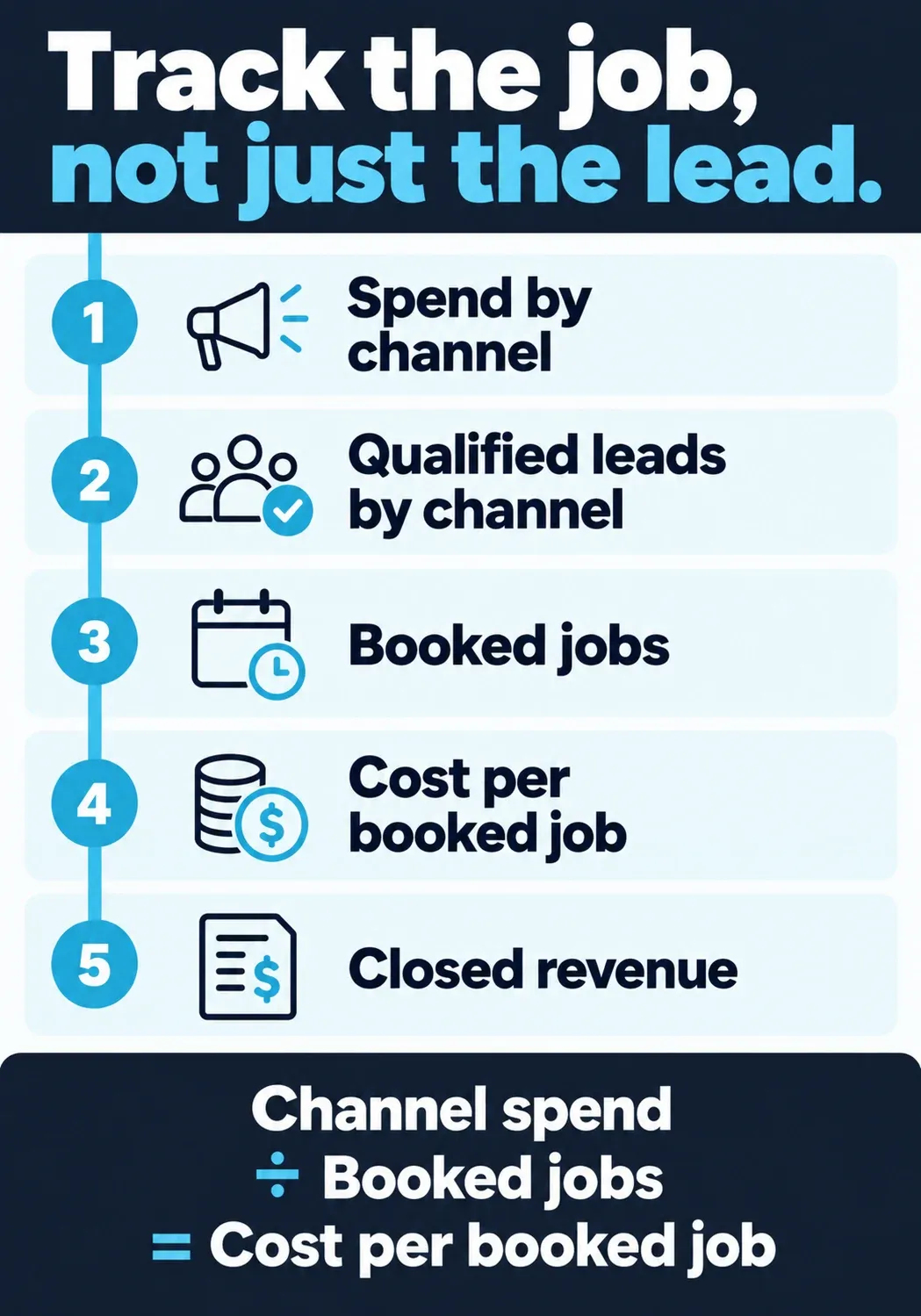
Connecting those numbers requires an unbroken source chain. Track each phone call, form fill, Local Services Ads contact, and ad campaign through your CRM directly to the sold job.
When you match marketing spend to ServiceTitan or Housecall Pro invoices, you stop guessing. That closed-loop data gives you the confidence to scale winning channels and cut wasteful spend immediately.
Call review serves as an everyday management tool.
Call tracking proves whether marketing delivered an unqualified lead or your front desk mishandled a bookable call. When a campaign generates twenty calls but zero booked jobs, call recordings reveal whether the targeting brought tire-kickers or your CSR dropped the ball.
Never let an agency hold your digital assets hostage. You should own your website, analytics, Search Console, ad accounts, call data, and every asset that produces your leads. If you ever leave, you keep everything you paid to build.
Ready to connect your marketing spend to closed revenue? Reach out and we will walk through it with you.
Frequently Asked Questions
How much do plumbing leads cost?
Plumbing lead costs vary widely based on your market, the specific service, call urgency, exclusivity, and your team's response speed. Advertised per-lead pricing is incomplete and misleading. To evaluate any channel, divide your total channel spend by your actual booked jobs, then compare that cost per booked job against your ticket size and profit margin.
How do you get quality plumbing leads?
Quality plumbing leads come from targeting homeowners actively searching for the exact service you provide, showing verified trust, and responding immediately. Your strongest owned sources include an optimized Google Business Profile, authentic customer reviews, focused service pages, local SEO, referral networks, and tightly managed paid search. Track every channel to confirm it delivers a profitable cost per booked job.
How do you get more commercial plumbing leads?
Commercial plumbing requires a proactive relationship system rather than emergency residential dispatching. Focus on targeted outreach to facility managers and property owners, commercial referral partnerships, relevant plan room bidding, and a clear commercial service offering on your site. Manage accounts through CRM pipeline follow-up, and evaluate every source by your true cost per booked job.